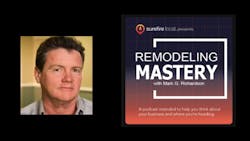
AI is more than a tool; it's a utility, says industry advisor Mark Richardson. In the latest episode of his Remodeling Mastery podcast, he addresses the rapid expansion of AI into the remodeling industry and presents ten tips on how to approach AI adoption and the conversations you have about it with clients.
Mark's tips for how to approach AI
- Educate yourself
- Focus on the questions, not the answers
- Have AI conversations with clients early
- Educate clients on AI
- Practice the conversations
- Consult the Pros
- Weave AI into your sales process
- Invest in the paid versions
- Leverage AI in drips
- Don't be scared, embrace it
Transcript:
Welcome to Remodeling Mastery. Remodeling Mastery is a podcast series that's really designed to help you think about and reflect on your business. What I try to do is take different topics or themes that I think are especially relevant and important, and really discuss and share some insights for these.
But in addition to some of the insights, I try to give you some specific tips or takeaways so that you can potentially put some of these things into action. This week, I want to talk about the notion of AI. Now, AI has been, needless to say, in the news; it's heavily in your business. You're starting to hear more and more about it from all different angles.
So it's not necessarily a new and special topic, but I want to approach this theme today a little bit more: is AI a friend or is it a foe? And with that notion in mind, I think you have a choice in terms of how you think about it, how you approach it. Now, it's interesting, the last three meetings that we've done at Harvard's Remodeling Future have had a substantial amount of time devoted to AI, AI within the business, AI in terms of impacting the industry.
And this last session a couple weeks ago was really focused on AI and the consumer kind of engagement with AI. So this session today is really not so much an AI primer or certainly a technology focus, but it's really more helping you to really get your head around the subject. I think it's always important when it comes to anything, especially when it comes to AI, to really try to be in the wave, not ahead of the wave or behind the wave.
AI is moving so fast that you really don't want, on the one hand, for it to crash on you because you're so far ahead of it, or you don't want to fall behind. I was listening to a speaker about a year ago talking about the adoption of the technologies in the marketplace, and they were saying that it took about twenty years for the full adoption of the internet in your business and, certainly, how the consumers embrace that.
However, he also was saying AI full adoption is gonna be two to three years. So, this is happening clearly so fast that you're not gonna have a lot of time to sit on your heels and really reflect on this. Now, Google, for example, has always said we've been in the machine learning business. It wasn't popular years ago to talk about AI.
However, they've been in the AI business, and it's existed. I think we just haven't necessarily looked at it the right way. But in the spirit of what am I seeing out there? What are others doing? How do you measure up? One of the interesting things that I'm seeing out there is probably ninety-five percent of the calories when it comes to AI are being spent with remodeling businesses on making your business more effective and more efficient.
However, only five percent is on what I would consider the biggest impact of AI, and that is gonna be your consumer and how your consumer is really embracing it. I've said for many, many years, your biggest competitor out there in the remodeling space is the consumer, not other builders, other remodelers, other architects, and other designers.
It's the consumer themselves. It's their fears, their fears of making mistakes or getting ripped off, or just the overall confusion. It's their ignorance. They really don't know how to necessarily buy remodeling. So I think that you're competing against that ignorance, but you're also competing against their overwhelm.
And overwhelm is both in terms of time, but it's also in terms of choices. And I think when you think about AI, it's really kind of a fourth competitor in itself in that we used to think about AI as a tool. However, we had a speaker at Harvard who said AI is so much more than a series of tools.
It's not just taking, for example, a nail gun and using it in lieu of a hammer. It's more of a utility. It's more like electricity. It's involving anything and everything that we're doing out there, and therefore, I think it's really critical that you are looking at AI the right way. There are so many different people out there that are adopting AI at different speeds, not only your team members, and you think about those that are kind of giddy about AI and those that are more the high-touch and resisting it.
Your homeowners are also, I think, similar in that respect. Where I really got jazzed up about what's going on with AI in terms of the impact on the consumer really happened about eleven months ago when I was actually working with a design-build firm in the Southwest, and they were saying how great of a year this was gonna be for them in terms of clients and projects and designs that were lined up for this particular year, 2026.
Well, I happened to have a call then, about thirty to sixty days later, with the same company, and he said, "Mark, we've just lost in the last thirty days about twenty to thirty percent of our business to AI." And that was really kind of a shocking thing. And I went a little bit more deeply with him, and he said, "We work in a very tech-savvy part of the community here, and we have many of our clients who have really embraced AI, certainly in their lives, but they've embraced it in terms of their project, and they've questioned and redesigned what we've come up with.
"They've looked at different specifications that we've come up with. They've found different costing models, and they're even looking at the overall scheduling and the flow of their projects really differently. And they've just told us that, 'While we really like you guys, we don't necessarily see the value in having more of a professional service like this.'"
So it was a little bit of a wake-up call, not only for that company but also for me, in that, what's going on here? Are we really potentially losing projects to clients that are becoming more AI-savvy, and what's going on there? So in a recent Harvard session that we did on this, where Google actually- the head of their home services- one of the things that he shared, which was such an important insight in terms of how things are changing as it relates to the consumer and AI, is that literally two or three years ago, I think for the most part, it was really an information gathering.
It was no different than doing Google searches on different things. You're gathering information. Where it's very quickly, even now, becoming more intelligent for the consumer. And if you really think about that, intelligence involves helping them really make decisions, not just giving them information to make decisions, but actually asking the AI to give advice in terms of what the decision is and how you go about making the decision.
And then the next step, which we haven't really fully embraced but we see coming, is the execution, and that is AI will be heavily involved in the actual execution of this intelligence that they're providing. Now, you might not think that that's necessarily likely and possible based on the remodeling activity and the consumer, but certainly the experts and the pundits out there see it really coming.
So I think embracing this topic and subject, which is super important. Now, as I watch and I see out there different individuals and companies that are embracing this, the ones that are, I think, focusing on really a balance, a balance of the high tech with the intelligence and then with the high touch.
I think more than ever, you've gotta redefine what your role is when it comes to AI and the consumer. For many years, I've been speaking that it's so important, I think, as a remodeler is not to be a remodeling peddler, but to really be more of a remodeling therapist. And being a therapist, there's certain skills that you need to be a therapist.
Being a financial advisor and knowing how to not only talk about the levels of investment and the financing and how they approach the project, but also understanding the language and the words of a financial advisor. Being a marriage counselor, I think, is so important as a remodeler in terms of giving advice, because needless to say, all partners or all spouses don't necessarily see things through the same pair of eyes.
And oftentimes the reason a project's not done is because it gets stalled because it's a disconnect in terms of the actual spouse's priorities and what they wanna accomplish. So being a marriage counselor is really critical. And then obviously, with the complexity of the products and the overwhelm and the proliferation of everything that's going on out there, being that tour guide to make sure that they don't step in potholes and bear traps.
But I think today you also have to be that AI or RI, remodeling intelligence, for the client. And you have to be very skillful of how you go about approaching the topic, how you approach the dialogue and the discussion. But I think more than ever, you've gotta have the knowledge to be able to do this.
So I wanna walk you through what I think are maybe 10 little tips, 10 pieces of advice, 10 insights that may help you either get out of the gate or really see how you measure up in terms of these 10 things.
So number one on my list is you've got to educate yourself. Now, you may be real tech-savvy or not, but you have got to educate yourself. You've got to start spending 15 to 30 minutes a day just focusing on how do I raise my level of acumen when it comes to AI, but more specifically when it comes to the consumer in AI and what they're doing in terms of searching and the language of chat and Gemini and Claude and some of the others.
You don't have to necessarily abandon everything else you're doing, but start educating yourself and spending a little bit of time. There's this adage that knowledge instills confidence, confidence creates enthusiasm, enthusiasm sells. You cannot have the enthusiasm about AI unless you at least have the foundation of spending a little bit of time on the knowledge itself.
And spend the time not just on how can you be more efficient, spend the time on how the consumer is embracing the AI, whether it's in visualization techniques or whether it's in terms of intelligence and information.
Number two on my list that I've learned is focus more on the questions, not the answers, when it comes to AI. The big, big key to AI, I think, as much as anything for you as the sage and advisor to the client, is the prompts. Help the client with the right prompts, because you know and I know regardless what platform you're using, if you're not asking the right questions, if you're not giving it the right prompts, and one of the prompts that I heard not too long ago is a very simple one, is after AI gives you information about any particular thing, ask AI, "Are you sure?"
When you ask simple questions like that, you're gonna get very different insights. You're gonna get a different probability of what information that they're really gathering. So if you can focus on practicing the prompts and helping your client ask the right questions, the likelihood that you're gonna come back with a better answer is so much better.
One of the things with AI that we know is it does make mistakes. It does make mistakes based on the type of questions you're asking, and it's oftentimes misguiding as much as it is guiding. So really asking the right questions.
Number three on my list is have the conversations early with the client when it comes to AI and how they're using, how they're experimenting, how they're embracing AI. Don't be afraid. If you have a world-class initial call with a client, in that call, ask the client, "Have you experimented, or are you using any AI tools?" And then be able to go on to say how you are kind of an expert, or you have become kind of an expert in many of the things that you're doing.
I think they'll give you the keys to the AI car if, in fact, you have the conversations early. And don't be blindsided when the client comes back, because pretty much everyone that's doing anything in life these days is at least asking, I think, the AI some of the questions. So have it early in the conversation, and if you do that every time and try to make it easy for the client to understand, you're gonna be much more successful.
Number four, there are several people out there that are actually showing the client uses of AI in their initial in-home visits or in their Zoom visits. By being proactive and showing them different uses of AI, what you're doing is you're positioning yourself as that AI tour guide, as that AI expert.
It could be more a matter of just, in that in-home visit, take a few photographs of different things. When you're having the conversation with the client, asking them would they like to just play around with and have some fun with AI and see what it comes up with. It's a great way to, in the moment, be able to get insights about particular ideas and be able to flesh them out so that you can at least move on and get feedback and go in the right direction. But it also is a great way to position yourself as that expert. And if they see you as the expert, they're gonna be much more inclined to allow you to control the process rather than the reverse.
Number five is really practice the dialogue, the conversation. How do you broach the subject when it comes to AI with the client? Do you kind of have your tail between your legs and you're afraid if they bring this up? Or are you proactive in terms of bringing it up yourself? So practice the conversation. Take one of your peers, take your spouse, take whoever, recording, and just practice having the conversation with yourself or with one of your team members about AI so you can feel comfortable in the dialogue.
Now, I keep saying dialogue, dialogue, dialogue. A dialogue is two-way. You ask the question, the client responds. You then say, "Well, would it be helpful if..." Of course, they want you to be helpful. So, "Would it be helpful if I showed you some examples?" The client is nine times out of ten or ninety-nine times out of a hundred gonna let you have the keys to the car and really drive the conversation.
Number six on my list is there's a lot of pros out there. There's a lot of pros within your company, and certainly in the industry, that are experimenting with different techniques and uses, both of the technology in terms of AI, but also a lot of the software companies out there, a lot of the different organizations like Haus or Engage or others, they're positioning themselves because they've been utilizing AI for a period of time to not only weave this into their fundamental products and services, but also to become kind of an expert on this.
So I think certainly having conversations, focus groups with other pros of different techniques of how are they handling AI objections, how are they approaching different things, because these are kind of things that'll take your game to the next level.
Number seven is a little bit more tricky in that if you have a very established sales process, think about ways that you can weave in AI into your sales process itself. Some of the people that I work with are actually weaving technologies into their story. It's not just a story about your process, your products, your history, but it's also your strategic alliances and how you're embracing different technologies, including AI, in the client experience.
So weave this proactively into your story, and I think if you can do that, you're gonna find clients are gonna be much more comfortable working with you as opposed to you arm wrestling with the topic.
Number eight on my list is think about getting the paid versions of the AI platforms with chat, or certainly Gemini or Claude. I think a lot of people, they get a little bit concerned about some of the paid, higher-level subscriptions, but AI is here. It's not that expensive to add it, both for yourself personally, but also professionally, to have more of the paid version. And I think if you do that, you're gonna get a lot more opportunity for additional prompts and all that in the course of using it. So don't be penny-wise and pound-foolish. Do invest a little bit of money into the paid versions as well.
Number nine, I put in the category of drips. You wanna leverage, I think, AI in terms of as many drips and opportunities. So if, in fact, you have the conversations up front with a client over a world-class initial call, you might send out a drip or two.
If, in fact, you get a photograph or two from them in that initial call that you might leverage AI in the course. So just to give the client a little bit of a taste test after your in-home meeting to keep in touch. Leverage, I think, AI in some of the drips that you might send back to the client.
Your drips are not necessarily giving away the farm. Your drips are something they already have access to, but it's a way to keep in touch in a very proactive way with the client. So think about the drips before and after, and how to leverage and utilize AI in the process.
Number ten on my list is, this is not intended to be painful or scary or fearful. I certainly understand those waves of emotions, and certainly I know how disruptive clients can be to show up in a meeting having all the ideas and things they're pulling together and doing kind of research in the evenings while they're working on these projects and those kinda thing.
But try to have some fun in this process. AI is really there, as I said earlier, not just in the past for information, but for intelligence and in the future for execution. But try to have some fun with it. Don't be painful. Don't try to fight it. Try to make AI really more of your friend and not a foe in this process.
And I think you're gonna not only see more success, but as I've seen with several remodelers and individual top gun salespeople, they're actually seeing their close rates go up, not go down, as they've invited AI into the process. So I thank everybody for joining us today, and I look forward to speaking to you again soon. Take care.
About the Author
 Mark Richardson
Mark Richardson, CR, is a speaker and business growth strategist. He authored the best-selling books How Fit Is Your Business?, Fit to Grow, and The Art of Time Mastery. He also hosts the podcast Remodeling Mastery. He can be reached at mrichardson@mgrichardson.