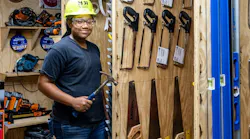
The Mosby Remodeling Academy: Building a Skilled Workforce From the Ground Up
Key Highlights
- Hear how the Mosby Remodeling Academy was initially conceived and how it came to fruition.
- Learn how a training curriculum was developed to combine classroom instruction, hands-on practice, job-site experience, and mentorship.
- Understand how program costs were determined.
- Hear how they selected apprentices, what they look for, and how the inaugural class is coming along.




Transcript
Jay Schneider: The residential construction industry is facing a very significant shortage of skilled tradespeople. The National Association of Home Builders said the shortages are particularly acute among qualified carpenters, framers, roofers, and plumbers. Additionally, the National Association for the Remodeling Industry lists on its workforce development page a need for 454,000 additional skilled tradespeople. I could go on. There's a lot of data out there, but you get the idea. So, one of the biggest issues is what can be done to address the problem.
Hello, I'm Jay Schneider, senior editor for Pro Remodeler, and in this podcast, you'll hear about the Mosby Remodeling Academy. The program was started by the design-build firm Mosby Building Arts, and it is a three-and-a half-year paid apprenticeship program that combines classroom instruction with hands-on training in the field.
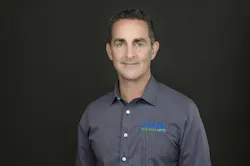
The program was envisioned by Mark McClanahan, Mosby CEO, as a way to address the shortage of skilled workers, and the curriculum was designed and developed by Tom Harland, a former public-school teacher who is now the field development manager at Mosby.
JS: Hello, Mark. Hello, Tom. Thanks for joining me today. Mark, I'll start with you first. Can you talk about how you came up with the idea for the academy and tell us a little bit about it?
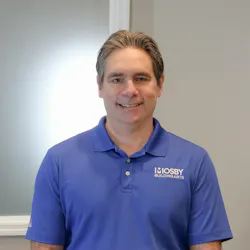
Mark McClanhan: So, in 2024, the management team at Mosby went through a strategic planning session, which we do every two years. And one of the things that we worked on was creating an artifact in the future, and it's commonly known as Mosby 2030. And in that artifact, there was a letter to the future board, a letter from me to the board describing what Mosby looks like in 2030, and some of the components are like we're going to be 50 million in revenue, we'll have 239 employees, we'll have these different products that we're going to be offering. But one of the other things that we said is we'll also have an apprenticeship program that will be putting out a dozen new apprentices a year. So that concept came up through that process and the strategic planning. The remodeling academy was a step in fulfilling that vision of most be 2030.
JS: Tom, the academy just launched on September 8 of this year, right? So tell us a little bit about it, the curriculum, and what the apprentices will learn over the three and a half years during the program.
Tom Harland: We are brand new into this first class of apprentices. We started with three, so we're going to start smaller and see how it goes and grow from there. So, we started three this September. We'll start another batch of them next year at this time. So, kind of keeping with a fall school year, and so it's a three-and-a-half-year paid apprenticeship where our design is for someone to come in with very little to no remodeling experience, and then we develop them to a point where they can do most items on our typical scopes with little guidance to being totally independent. So it's fairly broad as far as the bigger skills, and so framing basic trim work is where…well actually we start before that with the apprentices, with tools and safety, and just job site awareness and client communication and job site cleanup. And then from there we go from framing to basic trim work toward the end of that first year, and then get into a little bit of the more complex things that second year, and they learn windows and doors and hanging drywall and drywall patching and things like that. And then in the third year is when it gets more complex, so cabinet installation and crown molding and things like that, as well as coming back to those more foundational things, but learning to do more of the problem solving and what to do and those kinds of things. And then the last six months is really to help us to fill in gaps, understanding that each apprentice will therefore get a little bit of a different experience because in remodeling, you could be doing just about anything at about any time, depending on what job site you're on. And so, that last six months is a little bit geared toward more integrating their skills as a whole, filling in gaps, that kind of thing.
JS: Is there a test they have to go through or pass in order to move on to the next level, or how would you evaluate how well they're doing after the first year, the second year, third year, etc.?
TH: Yeah, that's a good question. So, they have in-person hands-on courses once a month, and that's with our trainer. And our trainer is evaluating them on the actual skills. How are they doing with you know what we've placed in the objectives within the curriculum, and so they are asking them questions orally, watching them as they work on it independently and with their other classmates, and recording it that way. But then each apprentice also has a mentor, and so we are in constant communication with the mentors to see how they're doing and specifically related to the topic that we just covered. So, if they're doing basic framing, we want them on a job site where framing is happening, and with our mentors checking in on them to see how they're doing. Are they able to do it independently along with our trainer visiting them on those job sites? Although there's some online coursework with some online testing also, but we're much more focused on are they able to perform it on the job?
JS: Tom, you mentioned online work. Do they practice their skills before going into the field?
TH: So, they're in the field right now. They went through two weeks of onboarding with us, where we really tried to prepare them safety wise, getting comfortable with tools, things like that, before sending them out with their mentors. So, they they'll be picking up on some skills, obviously that we haven't officially taught them yet. They'll still come in for the official coursework on that. But yeah, so there's going to be monthly coursework. They're learning the skill. They're in here for it's usually one course a month. That's either a half day or whole day session where they're learning the skill, practicing the skill, and then for those more complex skills, bringing them back in for some more practice in the facility, and then the guided practice on the site, and really just trying to get them as much repetition on those foundational skills as possible.
[Here's Mark talking about the training facility]
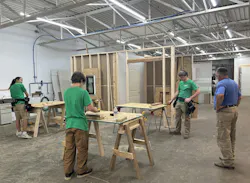
MM: We invested in a training facility that used to be our old warehouse where we stored all of our cabinets and fixtures and things before we did go to the job site. So, we have a new warehouse, much larger warehouse for all of our construction work. But then we took our old warehouse, which is about 4,000 square feet, and put it in the classroom and some vignettes for the trainers to work in.
JS: How did the apprentices find out about your program?
TH: We've taken a few different angles here, but the recruiter and I did a couple of job fairs. We went to job fair in our area that's geared toward high schoolers and got the word out that way and then spread the word throughout the company. Hey, if anyone knows anyone who's interested in learning a skilled trade and got the word out that way and through social media.
[But the biggest focus is on high schoolers. Here's Mark]
MM: So, the program is aimed at high schoolers leaving high school, and this is an alternative for college. So, we intend to make it an evergreen kind of effort to develop relationships with high schools around the area. That is our target audience: teens coming out of high school.
JS: So, for your inaugural class, you have three apprentices. Did more than three people apply?
TH: Yes, we did have more than three that applied, and as far as how do we choose, we were really looking for both people who we were convinced were looking at this as not just a job or not just a ‘oh I'll try it and see if I find out if it works out.’ More people who were looking to start a career in the skilled trades and then looking for things like grit. Just looking for people who we are confident will be able to stick through it. You know, if it gets a little bit tough at the beginning, you know, will they will they still stick it out? Then we did have an interview process.
MM: Tom, there's an assessment that they take too, right, regarding some simple math and things like that as well.
TH: Yeah, we really wanted to ensure that we're students who had at least taken academics seriously.
JS: And this is a paid apprenticeship program, so this is essentially their full-time job, right?
TH: So, they come in at basically the wage that we would pay a laborer, and with the understanding that they're going to be able to be productive the longer they're in the program, and so with plans to raise that compensation each year until graduation.
JS: And I'm assuming the objective is for you to hire them on full time. So, are they required to then work for you a certain period of time after the apprenticeship program ends?
TH: That's where it gets a little bit more complex to describe how we are doing this, but one of the things that upfront we wanted to do is to really communicate that this is something that is a value. It's a value to them, so we don't charge them tuition upfront. But there is a tuition that is prorated, and so for every month they're in the program, they're racking up. Okay, this is what that tuition would cost you. Again, they don't have to pay it up front, but then half of that is at graduation, and then the other half is slowly forgiven as they stay with us for another year.
JS: How did you determine what cost to assign to the program and how much there is to forgive?
TH: We know how much a trade school costs, and we also know that you go to, say a carpentry trade school, you're not necessarily learning the remodeling skills, and you're not necessarily coming in with the experience. And so those are just things we considered as we set this, and so then we thought, well, you know, how much how much effort are we putting in on our part, and how many training hours are they using, and so on. And by the way, we also we didn't want to overly burden anyone, you know. So, we set the value of the program at $9,500. And so, like I said, it starts at zero, you know. Right now, they're pretty much at zero still, as far as what they would pay back if they were to leave now. But you know that goes up on a on a monthly basis over the three and a half years, and then again, half of that is forgiven at graduation, and the other half if they stick with us for at least a year. But a major goal is to be able to really build up our team from the ground up and teach them the Mosby way from the very start.
JS: So, Mark, how much of a labor shortage are you experiencing? Three apprentices is a good start, but even when you get up to three annual classes with 12 apprentices each, will that fill the labor gap you're experiencing?
MM: You know that's a great question, Jay. I think certainly 12 a year would be, and you have to remember that's 12 new ones a year. So, it's not just 12 at one shot. So, you know the math 12 I think was more of us just coming up with a number. We didn't know exactly whether it's going to be 12 then, five then, or 20 then. It could be more. I think we wanted to kind of at least have a marker that we would aim toward, and you know, I mean, skilled labor is an existential crisis for our industry, and we cannot continue to rely on stealing other people's labor to fill our needs. And we have a full-time recruiter on staff to steal labor. We have to, and that's just the business we're in, unfortunately. And so, we're trying to use this as a way to balance those two efforts out of recruiting efforts versus how do we train people to be the skilled workforce that we need.
JS: Tom, earlier you mentioned your ideal candidate would be one that took high school seriously and had some grit. Are there other types of people you're hoping to get in the program, like women, for example, or minorities.
TH: Absolutely, I mean, as far as wanting to be as diverse as possible, and our inaugural class does have one woman, so yeah…
JS: That's a third. That's a pretty big percentage,
TH: It is. And let me just say that she just killed it in the interview. She's great.
JS: Just a little bit earlier, I'd asked you about how much cost Mosby is forgiving, but the company does incur a cost for this program, right, Mark?
MM: None of this is a money maker for us right now, but there is a cost. And essentially, what we did was…let me back up. The apprentices are on the job sites working, right? However, they are paid separately, so there is a direct cost for them to work on the job, but they're not hitting the job cost. We are paying them as overhead, so there is that cost too. That's not really put in there as well. But eventually, because we're paying them as overhead, we'll see some benefit because they will be doing work on the job. They won't be nearly as efficient or as effective. So, my CFO, our controller, and COO all kind of did the math and crunched the numbers, and we have a burden on all of our hourly employees when people clock in, talking about field employees, and so we increase the burden very, very slightly to cover the cost. But this is an investment in the future.
JS: So, I know it's probably too early to say, like, how is it working out? But in the few weeks so far, how is it working out?
TH: Good question. So, it's funny because we really held on to them pretty tightly those first couple of weeks and didn't get them out onto a job site with their mentor actually doing the work until late the second week. So, we were spending a lot of time really just preparing them, not just for the tools and the safety, but we had a lot of talks about how do skills come and having a growth mindset and professionalism with your coworkers and showing up on time. And to answer that question, it's going really well. Those first couple of days, I know the trainer and myself, we were a little bit nervous because of the deer in the headlights look on their faces, and also, they're young and pretty anxious, pretty nervous about this. It's an adult job, and it is a huge step. And as the week went on, and they really had a chance to start, I'll say playing with the tools, safely of course, we really started to see a change in both their comfort level with us. And really one of the other things we noticed is since they had zero remodeling experience, they really didn't have any kind of way to connect what actually happens on these job sites, and so going on some job site visits and just looking at some of our jobs and our CRM and this is what a work scope looks like and this is what construction plans look like and they started to see the different parts of the job pictures of before and after and we really started to see that anxiety get less and less. And so far, they're doing great. The mentors have had nothing but good things to say, so far so good.
JS: Are all three on the same job, or have you separated them out so they're each working on a different project?
TH: They're separated out, so they're each working with a different team. You know, under the jobs that the project manager has, and so they're all in in very different jobs right now. We do plan to every few months rotate them through the mentors, so they're being exposed to different teams, different people, different mentors, and then as we go on further to actually expose them even more to you know, especially as we start targeting, hey, you know, we're learning baseboard this month. Let's get you on some jobs where you just have a lot of chances to do those big baseboard jobs.
JS: Was there any hesitancy on the part of your field supervisor saying, ‘Oh my God, and they've taken on a person who's 18, has never been on a job site before,’ or they pretty much excited about like, hey, this is a great thing?
TH: There really wasn't no, especially when they learned that their cost wasn't going to hit the job cost. That was that was obviously helpful in it. But no, I think they all see the importance of what we're doing. There really wasn't hesitancy, and we put a lot of that responsibility on the mentor, as opposed to the project manager, so the project managers can kind of, not keep hands totally off, but don't have to be as concerned with how are we keeping them busy, where are they going to be. We put that responsibility more on the mentors and on the field development team.
JS: So, it sounds like you spent two years making this happen. The letter was written in 2024, the time capsule, and then it just launched in 2026. Two years?
TH: Yeah, well, it's a little bit different than that because we really didn't start moving this direction until right about a year ago. But the prior year to that, there was a lot of building of the background to do what we could do, and so we spent some time with project managers or trainer to basically look at every single skill that we would expect different levels of our remodelers to be able to do.
JS: So again, it's really early in the program, but I do want to ask about lessons learned for other design build firms out there interested in doing something similar. What would you recommend?
TH: Well, I think one thing would be not to rush it. Like I said, it has been kind of a process that got us to this point where you know if you would have asked us two years ago, from my perspective, I would have had a really vague idea of what this would look like, and so it needed time to simmer. It needed time to work out all the details of what skills you need. What does it look like? And just taking the time to determine all that, to have the full curriculum, to not just try to wing it. And then I would also say taking the time to really try to find the right apprentices I think is important too.
MM: I'll share one other thing with you related to what Tom said. We tried something similar to this many years ago, 7 or 8 or 9 years ago, where we would bring in an unskilled person. It was a year-long program, and then they got a job. Essentially, they came in and they were still paid, but they were paid at a lower wage. And once a quarter, we would switch them from one project manager to another, and then we hoped they would learn on the job. And then after a year, they would go off and you know be on somebody's crew. And it had very limited success. There wasn't any curriculum. There was no way to measure them really. So, I think Tom's wisdom here is just take your time, be really thoughtful about it. It's not happening overnight, and what I'm hoping over three and a half years from now that'll be the first class, and we'll have two, three other classes. It's a long play, not a short play, and I think we try to make it a short play before.
JS: You know, this is great. Thank you for talking with me today about the Mosby Remodeling Academy. Looking forward to hearing about how everything's going a year or two from now.
MM, TH: Okay, thanks, Jay. Bye.
JS: Thank you for listening.
You can learn more about the Academy at MosbyRemodelingAcademy.com. The Pro Remodeler Podcast is a production of Endeavor Business Media, a division of Endeavor B2B. Until next time, I'm Jay Schneider. Thank you.
About the Author
 Jay Schneider
Senior Editor
Jay Schneider is the Senior Editor for Pro Remodeler. He can be reached at [email protected].