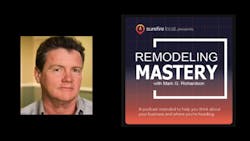
You may not be able to have one to two hours a day to train, but you also need to have more than one to two hours a month to train, says industry advisor Mark Richardson. In this episode of Remodeling Mastery, he discusses ten common mistakes he sees companies make with their training and the practice tips he recommends to fix them.
Mark's practice tips
- Make a list of why
- Conduct a sales fitness checkup
- Have a practice plan
- Role-play
- Make yourself a priority
- Get feedback
- Believe in the practice
- Be realistic
- Think of your vehicle as a mobile university
- Get a coach
Transcript:
Hi, I'm Mark Richardson, and welcome to Remodeling Mastery. Remodeling Mastery is a podcast series that's really designed to help you think about and reflect on your business. I try to take different topics that I think are especially relevant, relevant in terms of kind of the higher level of the market dynamic out there, or even more granular into the individual businesses I interact with and certainly work with.
Today, I'm gonna be talking about a topic that, quite frankly, is a time-proven kind of topic. It's so important, I think, when you kind of think about it, and I'm really gonna get a little bit more deeply into two fundamental parts here. And the real focus of this, though, is gonna be: How do you go about mastering practice within your business? And what I find when I'm out there talking to different remodelers and working with different companies, while many, many companies think they're doing effective training and practice within the business, but they're really not.
I draw the parallels all the time to different activities, and I think about the practice that people are doing in terms of sports, and they may play one game or two games a week; however, the rest of the time is filled up with the practice. I think about the military. I had a higher level Army colonel come and talk about the dynamic of how the military practices, and one reason they're so proficient when they go to war is that during peacetime they're doing a lot of practice. Now, needless to say, your business is a little bit more difficult because you're flying the plane, and Mark Richardson at least is telling you to practice at the same time. However, like in sports, like in different things that are going on, I think that is very much the case.
I happened to be taking my grandson to the fire station, and I watched the firemen out there working on particular drills that they were doing, and I asked the fella, "What are you doing?" He said, "We're training." And I said, "Well, how often do you all train?" And he said something I'll just never forget. They train as a firefighter one to two hours a day training. You may not be able to have one to two hours a day to train, but you also need to have more than one to two hours a month to train, because if you don't train, you're not gonna take your game to the next level, and you're not gonna see the outcomes you wanted.
During the crash of 2008, I was actually in 2010 leading a group of top remodelers around the country, and there were fourteen different individual leaders, companies. And of those fourteen, I asked them, from 2008, the crash, to 2010, how many of them had seen an increase in terms of the sales volume and effectiveness in terms of growth of the business. And of those, there were nine that didn't and five that did. And then I went on to ask each one, "Have you increased the level of training or decreased the level of training because of an overhead expense in that period of time?" And what was fascinating is the nine that had seen their business go down or had not increased their volume of activities, they had decreased the amount of training that they were doing before the crash in 2006, 2007, and the other five had increased it and seen an increase in their business. It was really very validating that practice does make a difference, and I think the more that you can develop that mindset.
So before we get into the practice techniques that I'm gonna give you today, I do want to follow this one theme that I've spoken about certainly before, and I actually have other podcasts you can go back and listen to, and it's this whole theme that training is an investment, not an expense. Now, I actually was on a panel for Georgetown University many, many years ago, where one of the other panelists that was on there was from a chicken restaurant chain, and that was one of their fundamental themes, that training is an investment, not an expense. And he unpacked how they go about doing training within that particular discipline. And it was really clear that it all starts with the right mindset, and that is that when you start to think about the training that you're doing and the practice you're doing as more of an investment and not an expense, you expect a return on that. You treat it with a degree of reverence and importance in terms of that level of investment, because doing it poorly is not gonna give you the outcome and the routine.
So here's ten mistakes I see, and some of these are head trash mistakes, and some of these are more tangible, specific mistakes, but I'm gonna give you just ten mistakes. And I'm hoping at least they're a little bit of a wake-up call, because I know many of them will hit a chord for you, and I'm gonna give you those before I actually touch on some practice techniques I think that help to counterbalance some of these mistakes.
Number one mistake I see with organizations out there is that they look at training as being optional for their individuals. If you were on, for example, a high school sports team or even a pro sports team, is going to practice optional or not optional? No, it's not optional. So going to training and practicing needs to be mandatory and not optional. I saw one organization that, under one kind of leadership, it was not optional, and they were doing very, very well. And then the new leadership came in, they made it a little bit more voluntary, and all of a sudden, the results started to drop. So one of the things I think is a big mistake is if you truly believe in training, you truly believe in practice, it is not optional. You've got to create a culture that's an integral part of your success formula, and it must be done.
The second is many leaders, whether production or sales leaders, they think they need to do all the heavy lifting with training. That's really a mistake. Matter of fact, it's usually not very effective training, because I think people on your team shut down after a period of time if it's the same voice that's presenting the training and the whole thing. So one of the things I encourage is that the leader, whether it's production or whether it's leader of the company or leader in sales, leader in design, they need to be more of an orchestra director of the training, and then the individual musicians are actually doing the necessary training and activities. And when you start to think of yourself as being more the choreographer of the training and not necessarily the doer, not only is it relieving a lot of the stress that makes it difficult to do, but it also, I think, makes it much, much more effective for the team as well.
Number three is that there's this adage that, when I find people are struggling with an individual on your team, one of the things I remind them of is this overall theme that's important when it comes to training as well, is that if someone's not working out on your team, most of the time it was either a bad hire or it was bad training. Now, when you isolate those two things when it comes to the individual, it helps you to unpack that question. But more importantly, one of them is bad training. And therefore, if you're not doing the training, and it's really your responsibility to make sure you create a culture and that individual is dedicated, and team is dedicated to the training, that's really required.
Number four, I see a lot, is making training kind of optional from a scheduling point of view. It's like the first thing that gets clipped from the schedule when something else comes up. "Here, I've got someone coming into town, and therefore let's skip training." "I got this other initiative. We'll use the training slot for that." If you have a weekly, biweekly, or monthly training, "We'll cancel the training and plug something else in." So if you really believe training is an investment, treat it with a level of reverence that you do. You don't move church from one point to the other or just cancel going to it. No, you don't cancel your trainings. You gotta make it somewhat religious in terms of it happening, and it is a priority kind of activity.
Number five on my list was not everyone needs to be trained. What's interesting about that is if you look at veterans in anything, veterans in sports, veterans in music, they're all still the veterans. The pros are investing in training. Are the veterans on your team that are really bringing, oftentimes, in the higher level of production or high level of sales, are they getting the right level of training in terms of sharpening their ax? It is for everyone. It's not just for the onboarding and the new folks and the rookies or the journeymen. It's really for the veterans as well.
Number six is, because it is an investment, you gotta think about the ROI, the return on investment of training. Now, the return on investment can in fact be quantified. You just have to look at it that way, and the only way to quantify it is also to measure it and measure and see how you're doing. Now, if you have one or two trainings, don't expect all of a sudden someone after they get out for a run or something are gonna be trained to be a runner. No, it takes time, but you do have to measure and track that success and have the right return on investment.
Number seven on my list of mistakes is, oftentimes, we kind of have our top guns or have our veterans and what have you out there doing it and producing results, but we don't necessarily tap them on the shoulder enough to do training. One of my friends, Larry Meadows, he had a little adage in his company, and that was, "You learn it, you do it, and then you teach it." Everyone becomes a teacher of the company, and I think it's a mistake not to expect everyone to mentor, everyone to teach, everyone to be tapped on the shoulder on something that they're really, really good at to be able to help others to do.
Number eight is oftentimes trainings are just not very interesting. They're boring. They're just not really as effective as they need to be. And I heard Daniel Pink, an author who's written a bunch of really wonderful things, say at one time that when it comes to speaking or when it comes to training, there was really three things that you needed to make sure that you were focused on in creating effective speaking and training. One of them is levity; you wanna make sure that it has a little bit of looseness, a little bit of interest, a little bit of think-out-of-the-box surprise, so to speak, some levity in the training. The second is brevity. You wanna make sure that it's the right length of time. Don't make it grueling, that it's too long. And then the third thing is relevance. You wanna make sure you're training on relevant stuff, the relevant issues, be it objections or client experience or whatever those things are, but you have to make it really relevant. So make sure levity, brevity, and relevance, you kind of check that off your list.
Number nine on my list was that oftentimes trainings aren't fun. Trainings can be fun. I know over the years I've been dedicated; it's oftentimes, think about how do we make it more fun? Well, making it interactive, making it more competitive training, but also leveraging other things. Leverage, for example, some game shows that have models out there to be entertainment. So if you can find ways to make it fun, the likelihood that it's gonna be a little bit more interesting, but most important, sticky, I think that that would be good.
And then number ten, which I think is a mistake, is you don't create a culture, a culture in your company of training. Now, culture is something that takes time to really create and build. I know my friend Brian Gottlieb, when he first got into business, he said, "I thought I was in the remodeling business, and I was really getting the blocking and tackling. Then after about six, seven years, I realized I was really more in the marketing and sales business, which is generating leads and closing deals," and therefore he could produce the stuff. Then about five years later, as the business grew, he realized it needed to become a training organization. And I think if you can develop a culture of being a training organization, or the flip side of it, if you don't do that, then it's a real mistake, I think, when it comes to training.
So I'm gonna give you a few tips here, a few tips on how to master practice. Now, this whole notion of mastery is such an important topic. There's four levels of mastery. The level four that you want everybody to get to when it comes to their skills or their mindset or their activities is where they're unconsciously competent. That means they can do certain things, and they don't have to think about it. It's just an automatic reflex. There's many things in your life that you're doing that you're unconsciously competent, like your morning hygiene and brushing your teeth. You don't think about how to put this piece of plastic in your mouth. You just do it. Why? Because you are level four mastery. We see mastery oftentimes in martial arts with the different black belts, and what's interesting is the different levels of black belt are not necessarily new techniques. They're just a level of unconscious competency when it comes to the activities that you're doing in that particular martial art. So four levels of mastery, and ultimately, you want everybody to not only improve, but you want everybody to take their game to the next level.
The second thing with practice, I think that's so important, and I heard this theme that I've certainly followed for many, many years: You need to have focus. You need to have laser focus with what you're practicing. You need to have a commitment to practice. The commitment to practice is, in fact, super important, as much as the practice itself. And lastly, you need to put in the time and the energy. You need to put in the time and energy. Ninety-two percent of New Year's resolutions fail, not because they're not a good idea to do. It's because of focus, commitment, and the time and energy that you put into it. So when it comes to this list of ten, think about it in terms of how you can do that.
So, number one thing when it comes to practice: It's a great idea to make a list of why you wanna practice. Literally, and it sounds a little bit patronizing, say, make a list of why. Make a list of the why. Why? Because I wanna increase my sales by ten to twenty percent. But I would even go deeper than that. What would that extra twenty percent of sales mean if, in fact, you accomplished it over the course of the next year? Second is maybe I want more delighted clients. Third is I wanna spend more time with my family; therefore I wanna save time, and by being better at something and been more trained at something, I can save time. Whatever those reasons why, make a list of why that you want to do the practice, because the practice won't be sticky. You won't stick with it if, in fact you don't have great reasons why.
Number two is take a little bit of a sales fitness checkup. It's like going to a doctor and having your blood pressure, your cholesterol, your weight checked, and then with that checkup, it's gonna reveal some things that I think are especially important, and that's the things that you tend to be a little weaker at when it comes to skills or the mindset, when it comes to the activities, and what you're more proficient at. Get some feedback from your supervisor, or take a little fitness checkup on your different team members. And I think when you go about doing this, what'll happen is you'll see the things that you're especially good at, and then you'll see the things that you could shore up and sharpen the ax and be better at.
What's interesting, I found, having worked with literally hundreds and even thousands of people over the years, is that people have a tendency to keep getting better at what they're already good at. Why? Because that's fun. Fixing the really problematic or the weak things isn't as much fun. So they'll gravitate to those, but they'll let those Cs and Ds on the report card just kinda hang in there because they don't like that subject or like that issue. If you can focus on the things that you're weak at and get that average GPA, so to speak, up, you will see amazing outcomes and results.
Number three is have a practice plan. The plan in all this, and start with something simple. Say, "I want a thirty-day practice plan, and I'm gonna do something every single day to practice." It doesn't take a lot of time. It could be thirty, forty-five minutes a day, that kind of thing, just like going to the gym or doing other things. I want a practice plan. I want a practice plan to what is my vocation and what I'm gonna get better at. And by mapping out a practice plan, which is gonna start with a brain dump, it's then gonna look at the time frames that are available, and then it's gonna literally be mapping out a timeline and activities on a daily basis or a weekly basis that you're gonna be committed to.
Number four kind of tip when it comes to practice, and I see this so often, is sometimes we confuse going to a seminar or listening to a podcast or those kind of things as practice. Yes, you need to do those kind of things, but when it really comes to practice that you're actually better at something, you've gotta get some calluses, scars, and bruises to practice. So how do you go about doing that? Well, one way to do it, I think, is doing some role plays. Role plays, it could be on client objections. Role plays could be on a world-class initial home visit. Role plays could be handling a tricky client situation in production. But you've gotta do some role plays, role practice.
Now, what's interesting about the word role play is that I bring that up a lot, and people sometimes cringe because they don't like the idea of being on stage and doing role plays. So change the word. I know a company I work with; they use the word role practice, not role play, and all of a sudden it's more comfortable. I would even go a step further. I was reading an article where this particular company calls it doing simulations, not role plays, and therefore it's less scary doing simulations, and you draw parallels to other simulations that people do, including learning how to fly a plane, where you're in a simulator to learn before you get up in the sky and potentially have the risk and crash.
But doing ride-alongs where other people are observing you, it could be one of your peers that you tap on the shoulder to observe you, or it could be certainly your coach or your mentor or your boss that gets out there with you. And be open-minded. Today, more than ever, you can leverage AI when it comes to role-play. Listen, do more of the recordings. I think homeowners are more accepting of having things recorded so that you don't have to keep notes, and therefore you can then review the recordings and get better.
Number five is a little bit more about you, and that is make yourself a priority. And what you have to do is treat yourself; make appointments to yourself to do the training. So if I'm looking at my next month here in terms of doing trainings for myself, I wanna literally block out and make appointments to myself. Make it in your calendar, in your Outlook, that you're gonna carve out these 30 minutes, 45 minutes, one hour to do these different activities over periods of time. If you can treat yourself with the same degree of reverence in terms of improvement and training that you do your clients and your team members, you're gonna most likely really take your game to the next level.
And number six on my mastering training is get some feedback. Get some feedback from your team members, get some feedback from even your clients, but get some feedback even your family. What are some of the things that you should sharpen your axe on? What are some of the things that you should practice? It might be your use of different language. It might be certain techniques that you use in terms of mastering budgeting in the remodeling process. But ask others what you think they think you should work on in terms of mastering, and put that on your training list as being things that you really need to do.
There's an adage that I think is so important that those that are involved in, I think, training and improvement really live by, and it's this simple little formula: A plus B equals R. A is about attitude. It's about the mindset, it's about the work ethic. B is the behaviors. They're the behaviors that you're actually doing in the training itself will give you the results. You've gotta believe that when it comes to practice, the results will come only if you adapt the right mindset towards practice, but also the right behaviors to do really the best practice. Perfect practice, not practice is perfect. And I think if you can do those kind of things, you'll see better outcomes.
Number eight, one of the things I always like to do, and I feel very, very, very strongly about this, you wanna be aggressive but realistic about this topic today. You wanna make it really a priority, but also be realistic. Realistic with your family, realistic with your clients, realistic with your team. So think of this as being more of a taking a one-a-day vitamin. If you can carve out maybe thirty minutes to forty-five minutes a day to focus on some level of training, go back to number three and have a training master or practice plan of what that is that you're gonna be practicing on. You're gonna, I think, be much more successful than you trying to eat an elephant in one bite.
Oftentimes people will come to a seminar or something, and they think at least they've been trained on something, but quite frankly, there is something called a forgetting curve, and by the next day, you've forgotten about half of what you learned that day, and then a week later, you've forgotten eighty percent of it. So by doing this on a regular basis, I think it's much, much more effective. So I love this whole notion of kind of a one-a-day vitamin. It might be listening to a podcast one day, might be doing some role practice, might be taking out a Top Gun or something out to lunch on the next day. But do something every single day that you can to practice, and I think you'll be better.
Number nine, and again, it's pretty simple, and I apologize, maybe a little bit patronizing, but start to think about your vehicle, especially if you're in a position that you tend to bounce around a lot, as a mobile university. How can you set up this vehicle to be a better mobile university? If, in fact, podcasts are the way to learn on different things, have them all keyed up and ready to go. When you start the vehicle, boom, it jumps right into that learning, so you have that. Try to really leverage and squeeze out as much time as you can, but the more you think about your car as that mobile university and not necessarily an entertainment center for you, I think you'll be more successful.
And then number ten, but certainly not last on my mastering practice, is get a coach. Now, get a coach doesn't mean you have to go out and spend a lot of money on a coach. Get a coach could be one of your peers in your business, and you just designate this person. "Would you mentor me? Would you coach me?" Get a coach. It's someone that can hold you accountable to what you're training for, but also potentially give you the insights. I like to watch professional sports, and if you think about yourself as a pro and not an amateur, and I think most of you do, think about that tennis pro. That tennis pro will have four coaches literally in the stands watching and giving feedback to that top pro tennis player. That professional golfer will have multiple coaches there to advise him on very specific things. Now, I don't think you need to spend a fortune, but everybody needs a coach. Everybody needs a mentor, whether you're the best of the best, like the best of the best athletes, or, in fact, you're just beginning. But if you don't have a coach, you don't have a way to hold you accountable and give you insights and help you improve; it's not gonna take your game to the next level.
So I wanna thank everybody for listening to this podcast, and just commit. Commit to yourself to get better at things, because once you commit and you can quantify what this can mean to you at so many different levels, you're gonna see a lot of success. Take care.
About the Author
 Mark Richardson
Mark Richardson
Mark Richardson, CR, is a speaker and business growth strategist. He authored the best-selling books How Fit Is Your Business?, Fit to Grow, and The Art of Time Mastery. He also hosts the podcast Remodeling Mastery. He can be reached at mrichardson@mgrichardson.