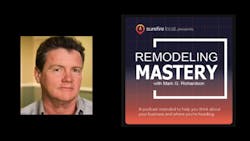
Your real competitor in the remodeling market is the consumer, not other remodelers, says industry advisor Mark Richardson. Consumers are naturally going to have a lot of fears and concerns when jumping into a remodeling project, concerns that will make them skittish enough to jump ship if you don't know how to properly address them. You need to have a game plan to properly communicate with your clients, which starts by answering the three "whys":
The Three "Whys"
-
Why do this project?
-
Why do it now?
-
Why do it with you?
Listen to the full episode of Remodeling Mastery to hear Richardson go into more detail on each question and why they matter when garnering a client's trust.
Transcript:
Hi, I'm Mark Richardson. Welcome to Remodeling Mastery. Remodeling Mastery is a podcast series that's really designed to help you reflect and think about your business, not just do your business. What I try to do is take different topics that I think are especially relevant—relevant to kind of the business, relevant to the industry, relevant to kind of consumer sentiment—to really help you, I think, think about and do the right things.
You know, there's so many balls in the air, so many variables involved with being able to focus on the key things. I think is really what this podcast is all about. Today I wanna address a question that is one that I think, as I work with and train and guide different leaders, I think is a little bit confusing out there. And if it's confusing for you, then it's certainly gonna be confusing for your client as well.
And that's the question of why. Why should they do this project? Why should they do it now? And why should they do it with you? When I ask teams these questions or leaders these questions, I oftentimes think that they're a little bit like a deer in headlights, and they're just paused because they're not sure of the answers to this.
But the more I think you can inside be that voice of reason for the client, to really guide them through those questions of why do this project, why do it now, and why do it with you, the more likely they're gonna proceed and do it in the right kind of manner and have a really successful remodel.
So before I get into, I think, the techniques of how to address the question, you wanna take kind of a couple of minutes to talk about the environment. You know, when we look at the last—let—in this industry, we've seen all, we probably see at the beginning of every decade some major things going on, and then oftentimes in the middle of the decade it's really more of stabilization and growth.
We, needless to say, are more in that stabilization and growth out there. However, clearly the environment out there is a little bit choppy. It's a little bit herky-jerky. But when we look back at 1980, we had interest rates above 16%. In 1990, we saw the economy soften to the point that the phone just wasn't ringing, just like it has been for some companies now.
You know, in the year 2000 we had Y2K and the tech bust. In 2010 we had the aftermath of the stock market crash. And then 2020, of course, we had COVID. And in COVID, you know, my predictions at the beginning of COVID were that a lot of remodeling companies would not make it. However, it completely reversed itself very, very quickly. And you know, my prediction later in that year was almost all remodeling companies would make it through.
I think that COVID, and in many ways home improvement and home remodeling, became the silver lining for those that were hunkered down at home.
So with that being said, you know that consumer is your competitor today. It's not other remodelers. You know, when you look at your market share, which I studied in our business many years ago—we were one of the largest in the country—and we had less than 1% of the market share in terms of remodeling spend in the activity.
So when you have a very small percentage of the market share and you're honest with yourself, your real competitor is the consumer.
Now when you unpack what do I mean by the competitor being the consumer, it's their fears. Their fears of getting ripped off, their fears of making mistakes, their fears of what's happening out there in the world. It's their ignorance. And now what's interesting with the technology and so much information at their fingertips, that ignorance has not necessarily gone down—it's just been colored in a different kind of way.
I actually talked to a very good remodeler down in the Texas area recently, and he said he lost a couple of projects in large part because his clients—his prospects—were doing a lot of their own research and leveraging AI in the process, using the technologies to be able to really make a big, big difference.
So as a result of these, you know, you've gotta understand that you have to position, you've gotta communicate, you've gotta let people know the value of working with you in the course of it, which is obviously the number three why. And certainly they're overwhelmed—overwhelmed with travel, overwhelmed with family and life in general. Their lives are just this long rubber band that's about to snap, and where's the space in their life? Where's the room in their life for the additional things like remodeling? And oftentimes the can gets kicked down the road.
So 2024 was a year of uncertainty. 2025 was about mastering the uncertainty. And my theme for this year, 2026, it's about a year of growth. Now growth can be defined in different kind of ways, but growth is all about how do I gain market share? How do I get that additional margin? How do I service my client base and grow my team in such a way to have growth? And I think the more that you adopt a growth mindset this year, the healthier you're gonna be.
So let's get to the real root of the issue here, and that's the three whys. So the first question—and I'm gonna give you a few tips for each one—but I would encourage you to sit down and write down your own list of these three questions: why do this project, why do it now, and why do it with you?
So the “why do this project” question—a couple of tips—is start to see yourself as less of a remodeling rep and more of a therapist, more of a marriage counselor, more of a voice of reason for the client. And I think the more that you can pepper in little insights of why to do this project—use stories, use metaphors, use examples—the better.
You know, I think one of my friends in the industry used to tell every single client, “We just can't let your house die.” Because if you start to think of it, a house is this living and evolving kind of thing. Certainly doing a project or proceeding with home improvement and remodeling is certainly an important thing to do.
So the more you can pepper in the data of why to do the project, I think the better. And some of that data can include what's the cost, for example, of moving versus staying in the home. Some people are a little bit surprised when I say this, but when you actually lay out the cost of moving, a good rule of thumb is it's about 10 to 20% of the cost of the new home. Why not take that $100,000 to $200,000 and plant it back in the home and really have the home that you really love and you're enjoying?
You know, why do it? It's a good investment. Think about all the crazy investments out there today. Your home is really a safe haven for investing. Now is it gonna give you a gigantic return like what we've seen with other things? Maybe not. But it is gonna be safe, and I think if nothing else, when and if you ever do need to sell the house, you're not gonna be embarrassed.
You know, I oftentimes will share with friends and former clients that imagine someone wants to come and buy this house in the future. What are they gonna say about this house if you don't remodel? What are they gonna say about this house if you do remodel? The more, again, I think you can help guide them. In one case they'll be able to move the house very quickly. In one case they'll be able to get the top-level sale on the house. In the other, if they don't do the remodeling, oftentimes they'll get the rock-bottom price or people will want to negotiate.
And then number three is a little less about the financial. What are the intangibles? What's the joy that you have in creating that new primary suite or creating that new kitchen or that outdoor living space? That joy, I think, is oftentimes where you really see a lot of the benefits. And the reality is we're all aging. Our children are growing, our parents are passing along. Why not do the project and make sure that you're at least getting all the joy that you can out of it?
Okay, number two is why do it now. Now you can point out a lot of the economic elements when it comes to why doing it now. Again, I encourage you—pepper these in. You don't just vomit all this particular data on them.
But one of the more significant ones is the level of remodeling inflation that we've experienced in the last five years. We've seen remodeling escalation be about 10 to 20% per year. So that $50,000 project five years ago is costing $100,000 now. That $100,000 is causing $200,000, and we see no sign of that necessarily slowing down.
So why do it now? Doing it now is very rational and makes sense economically because a year from now this project is gonna probably cost 10 to 20% more than it costs right now.
You also have more time to enjoy it. When you really get into the discussion with a client, how long do they see themselves in this home? How many summers are they gonna have left in this home? You just have more time to enjoy it. If in fact you go get it done now, it'll pay the dividends in terms of the fun and the enjoyment moving forward.
And the last—which is a little bit more of a client story that I would also encourage—when a client is asking about or they're dragging their feet about when to do the project, you can just simply say: in the last 10 years, 20 years, I've never had a client say, “I wish we would've put the project off.” I've only had clients say, “Gosh, it would've been great to do this while my mother was still alive. It would've been great while the kids were still at home for them to really be able to enjoy it as well.”
Putting projects off is not necessarily a good thing, especially if they have the clarity of what it is they want to try to accomplish.
So the third question is why you. And again, this is one that I think is a little bit tricky. I think a lot of remodelers have a tendency to say, “Oh, we do great quality work. We have a great team and a high level of professionalism.” But that's what everybody is saying.
So if you want to really impress upon the client why work with you, you've gotta do it so that you're different. And being different could be more about selling process, not just selling solutions. Being different is much more about coming up with different ideas, questioning what the client wants to do so that ultimately your solutions, your ideas, your direction are different than everyone else.
But also don't hesitate, when it comes to you, to really summarize what your sweet spot is of what you like to do. There's a company in California I work with—every single client that fits kind of their mold and their sweet spot—they will let the client know that this project really hits their sweet spot of what they do best.
Number one, it's a larger project, and they're really, really proficient. They've created projects, processes, and systems to be able to do larger projects, to be able to have the right technologies, communicate with the client, and manage large projects.
Second, it's more complex. They have strategic alliances and team members set up to do more complex projects. They have a huge amount of experience.
And then last, their clients really want more of a white-glove experience. Clearly, based on everything they're seeing here and what the client has experienced in the past, that's what they're really looking for. So whether you work with us or someone else, work with someone that fits that sweet spot—it's what they do best.
And I think that really helps you to communicate that. So the more that you can communicate to the client and be different, and really express in a very articulated way why working with you really makes sense, the better. And don't hesitate really talking about your depth of experience. Look at the collective number of years of all your team members and what it adds up to.
So when a client is really struggling with who to work with, just let them know: it's hard to put a value on 200 or 300 years of experience that our team has. People understand experience—no different than going to a doctor. Wouldn't you rather go to a cardiologist that does a hundred of these types of operations a year versus five?
And I think the more that you can communicate this in the right kind of professional way, the better.
So I wanna summarize. I do think there are some key things in this herky-jerky kind of environment that we're in.
Number one: go deeper. This process with homeowners today is highly human and extremely personal. Go deeper with the client. Let the leash go out a little bit further when it comes to the conversation. Don't try to qualify so deeply—even though you're busy. Go deep with clients, and it will make a difference potentially of getting one more out of 10.
Number two: you want to be very value-oriented in terms of your solutions. Many, many years ago this adage was used about upselling. Well, clients don't want to be upsold. Today I would argue that you want to sell down to clients. You want to suggest alternatives to their decisions and selections that will save them money. You want to give the client the feeling that you're gonna get out there and fight for them and really help them get the most out of their investment. Because that's gonna create not only the trust, but it's also gonna have them make better decisions, and you're gonna get higher close rates moving forward.
And then last, you really want to leverage your client base. Don't be strangers with your past clients. Many of you listening to this podcast have literally hundreds and even thousands of homeowners over the many, many years you've serviced. But we've become strangers with a lot of that client base.
Go back and really focus on that client base because that is gonna be where your future and sustainable and predictable projects will come from. So the more time and energy you're putting into your client base, I think the better you'll be.
So again, I want to just thank everybody for listening to this. Focus on the why. And as I said at the very beginning, if you don't know why they should do this project, you don't know why they should do it now, and you don't know why they should do it with you, then you certainly can't expect them to know why as well.
Take care, everyone.
About the Author

Mark Richardson
Mark Richardson, CR, is a speaker and business growth strategist. He authored the best-selling books How Fit Is Your Business?, Fit to Grow, and The Art of Time Mastery. He also hosts the podcast Remodeling Mastery. He can be reached at mrichardson@mgrichardson.