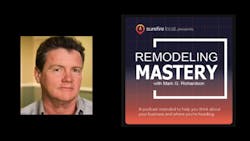
Businesses don't remain constant—they're either growing or they're dying, says industry advisor Mark Richardson. The idea of growth is complex, there is no simple solution, and the trajectory typically is not a straight line. And defining it is tricky because it's measured by various factors and metrics. However, one thing is for sure: growth is destined to fail without there being a specific plan and a commitment from you and your team to make it happen.
Listen to the full episode of Remodeling Mastery, where Richardson dives deeper into the concept of growth and how it affects you and your team.
Transcript:
Hi, I am Mark Richardson, and welcome to Remodeling Mastery. Remodeling Mastery is a podcast series that's really designed to help you reflect and think about your business, not just do your business. What I try to do is take different topics or themes that I think are especially relevant—relevant to the times, but also relevant to what I'm seeing out there in the marketplace.
Today I'm gonna be talking about a topic that is actually my theme for 2026, and that is: this is a year of growth. And as we discuss and talk about and unpack growth, growth is one of these simple concepts, simple words. However, it's got so much different complexity and legs and misconceptions about it that I want to really talk about and have you reflect and think about it.
In 2024, my theme for that year was: it's a year of uncertainty. It was a major presidential election. We were having a lot of things going on globally. We were seeing a lot of things herky-jerky. We'd just come out of COVID. So it was a year of uncertainty, and as I said at the time, uncertainty is not good or bad. It just is uncertain. And when things are uncertain—i.e., whether there's traffic or whether there's weather out there—you've gotta adjust your game and behavior to kind of be prepared for it.
2025, I thought at least the dust had settled, and I was moving to more of a year of mastery out there. But I realized once the elections and once the new administration was in place and we saw, you know, all sorts of things related to tariffs and price escalation and things that were much, much greater that, uh, it was really more about mastering the uncertainty. And that became my year of my theme for 2025.
You know, I was interviewed by a podcast host right before the end of 25, and he said, “Well, based on all this, what is your theme for 2026?” And I hadn't quite prepared it. However, what immediately came to mind was 2026, I think, is gonna be a year of growth.
Now, growth does not necessarily mean go-go times. Growth means it's a time to put your stake in the sand and say, “I am going to grow.” Now, there's a lot of legs to that word “grow.” What does that mean? How do you define it? And that's what I'm gonna try to do in today's podcast, is really give you some ways to think about growth maybe a little bit differently.
You know, I've always felt very strongly that a business is either growing or it's dying. Now, growth can be defined in different ways, but it's either one or the other. It's not just maintaining and being stable. It's about really how do I take the game to the next level?
'Cause I think for any business, any individual in sales or marketing or production, if you're not moving forward and growing and taking your game to the next level, you're declining, I think. And that's not necessarily either an admirable place or the place that you want to be.
So this notion of 2026 being a year of growth really applies to those in sales and those in production, and certainly owners of businesses as well. Today I am gonna be primarily talking a little bit more broadly and higher level at businesses, but I would encourage everyone—everyone—to really think about growth as they're moving forward.
You know, at the beginning of any year, we oftentimes make little resolutions. And these resolutions we call New Year's resolutions. What's interesting is 92% of those resolutions tend to fail. Now, they don't fail because they were not a decent thing to be resolved to. They fail because you really don't have specific vision and goal and commitment to really doing those things. And oftentimes there's not a monitoring tool in place to be able to make sure you stay on track.
So I share that because I think if this is a year of growth, it really is important to really spend the time thinking about this topic and thinking about what growth means to you.
Before I get into defining some of the different ways that people think about growth, I wanna talk about a few misconceptions. One misconception, I think, when it comes to growth is bigger is better. Bigger's not better. Better is better. And I think as you think about growth, try to think of it in terms of being better, not necessarily just being bigger.
There's a lot of remodeling leaders, remodeling companies out there that quite frankly are pounding their chest because they've gotten so much bigger. They're not necessarily better. They're not better for their team, they're not better for their clients, and certainly they're not necessarily seeing better results.
Another is that, you know, growth is not necessarily a straight line. When I'm working with many different owners on the growth and growth strategies of the business, oftentimes we like to make a nice little straight line. But the reality is you need to think about growth as having some ups and downs, some softness, some go-go times. It's gonna be more of peaks and valleys of growth. But ultimately, connected together, you're gonna see a line, and that trajectory of growth hopefully is gonna be in a relatively positive way.
I'm gonna talk about kind of what is the pace of growth and percentage of growth in a few minutes. However, I do think it's not a straight line, so don't necessarily—either when you've had a good year for growth or you've dipped down—look at it that way. In many cases, you've just gotta look at the cycle of growth—i.e., is it a three-year, five-year cycle as opposed to a one-year cycle of growth.
The other thing with growth is that many people are looking at growth purely in terms of top-line sales or revenue in terms of growth. And the reality is that, yes, that's gonna be one factor really for any business that wants to move forward. However, there are a lot of different ways to define growth at different times, and I'm gonna be talking about that shortly.
So before we get into, I think, some of those strategies, I do think it's important to ask yourself why. One of the most important questions, I think, for anybody to be asking themselves is why. Why should I grow?
Well, there are a lot of different reasons, but unless you know your reason of why grow, quite frankly, it's gonna be not only very hard for you to be committed, but it's gonna be very hard for you to get the team rallied behind it.
One that's especially interesting, especially today, is you think about as you march along from the beginning and the middle and the final stages of your career in the business: the business really is an asset. It really is an investment. And you may have that transition kind of mapped out for yourself, but right or wrong, it's an investment—and that investment can grow and grow and grow.
I've worked with many businesses. I've helped them transfer, sell their business, bring in outside investors. And I can tell you what started to be a very seed of a business maybe many years ago now has a level of wealth that's far greater than you ever, ever can imagine.
So one way to think about growth—which is a big, big factor in anybody buying a business—is: am I buying a baby business, or am I buying a big business or a medium-sized business? And that level of growth will determine the value of the business.
So understanding that dynamic—that growth gives you an asset—think of it almost like real estate that you're investing in and you expect a much, much bigger return.
I think another reason that you would grow is really to reflect: well, do you want to be doing what you're doing today three years, five years from now? And I think as humans it's very natural to want to take your own interest to the next level.
But if all you're doing for the company is doing all the sales, all the production in your company, or doing all the administration aspects of the business, that's not necessarily gonna be as fulfilling for you one year, three years, five years from now.
So it's the growth of the business that allows you to bring in and afford the right kind of infrastructure to allow you to take your game and your interest to the next level.
You know, I know for myself, going way, way back in my career, my initial passion was really wrapped around design. Then it became wrapped around how do I take the client relationships and grow clients through sales, and then developing that team to do that, and then the whole organization and what have you.
So my point simply is that your level of growth is a reason for growth. But you have to have some level of clarity. What is it gonna look like five years from now if you're waking up and doing exactly what you are today?
So if in fact you've got some of that clarity, I think that's gonna really help you.
So another reason, I think, to grow the business is really thinking about the value of some of your assets—your assets being your people. People are your greatest asset, I think, in any business. And they have that same question too. Do they want to work for a business that's either declining or flat, or do they want to be inspired by a business that's growing and has a real opportunity for them in the future?
So the point in all this—the why grow—there are so many different reasons. But you really have to be clear about that and certainly discuss those things with your team so that you have the motivation to be able to grow.
So with all that being said, let's talk about how do you define growth once you're clear in terms of what you want to do in terms of growth, especially over a period of time.
Jim Collins wrote about this. He said the two cycles in business that are especially important to think about moving forward—one of them is your three-month, your quarterly plan. You know, that's where the real action happens. That's where you inch things forward. That's really where the rubber meets the road in terms of return.
But the second is the 10-year plan. And the 10-year plan, in my opinion, is really more the vision. It doesn't have to be spelled out in detail, but it's much more the vision. Are you heading to the mountains or heading to the seashore?
And I think if you're clear in terms of that 10-year vision, at a minimum you have to have an understanding of where you're heading in terms of levels of growth.
So as you drill into growth and have more discussions about it with yourself and with your team, it could be focused on top-line growth. If you're a $2 million business, what does it look like to be 4, 7, 12, 15, and so on and so on all the way up?
It could be growing your client base. The reality is those clients and that experience—those clients for life—they're gonna want to see your level of growth. They don't want to see it being reckless, but they do want to see you being able to grow.
It could be, as I already mentioned, your team's growth. One of the things I think as you discuss this is ask your team about the right level of growth. It could be market share. It could be products. It could be services. It could be locations.
There's a lot of different elements when it comes to growth. But again, I can't emphasize enough: you've gotta spend some time defining the right level of growth for yourself.
What's also interesting is when you think about businesses and we look at generations of business. In many of the business books and business speak, we talk about first and second and third generation. Oftentimes the first generation is what gets you out of the box. The second generation is oftentimes where the growth is. But when you look at many businesses in terms of the third generation, we oftentimes see decline in the third generation.
So if you're in the second generation, it's absolutely normal to want to take it to the next level and grow it. If you're in the first, it's certainly possible. But if you're in the third, I would say be careful not to become complacent and not really appreciate what the second generation of growth has really done.
I'd like to think in growth—especially those that think of growth in terms of top-line sales or revenue—is what is a really comfortable pace of growth when it comes to those kinds of percentages.
And I find those companies out there that are really at kind of a zero to 5% level of growth in terms of top-line revenues or top-line sales growth—you’re actually slipping backwards slightly. There's so much happening in business today that's going faster than that that you're really maintaining what you've got, but you're probably slipping backward.
Now, for those of you that are looking at your 26 business plan and saying, “Oh my goodness, I'm only projecting three or 4% growth this year,” what you have to do is you have to look at it over like a three-to-five-year average. Because some of those years, if some of those years were 17, 18% growth and some are gonna be more in the three or 4% growth, then you need to think in terms of averaging those together.
And that might give you more of an annualized growth that's much more healthy.
Five to 10% growth—and I've written quite a bit about this in my Fit to Grow book—I think is, in fact, healthy. In tough times that may be all you're able to get. But for the most part, I think it's not necessarily an inspiring level of growth. It's not necessarily energizing for your team. It's not necessarily pushing like an athlete pushing to make the playoffs and beyond.
If you're at five or 10% growth, I don't want to say it's boring, but it is borderline a little bit on the soft side in terms of levels of growth. Again, average over periods of time.
I believe pretty strongly that the sweet spot is in the 10 to 20% level of growth. When I've studied different businesses, I took about five of the top remodeling businesses that I work with and really analyzed what their annualized level of growth was for the last 10 years.
From these businesses—most of which have grown to be pretty substantial businesses—their average over that period of time, when you threw it all in a pot together, was about 15% levels of growth.
And what they've been able to do in terms of wealth, in terms of inspiration, in terms of making a difference for the client—and certainly the industry—has been phenomenal.
Similarly, I've looked at another bucket of folks out there that oftentimes are on the cover of the magazines, but they haven't necessarily really grown. When you look at that same 10-year period of time, it's averaged one to 2% over that 10-year period of time.
So you really have to think about what is the right pace of growth. I would say if, in fact, you want to inspire the team, if you want to increase the level of the investment or the value this business is, if you want to fire yourself, so to speak, and be able to be doing different things, then you want to really try to be at that level of growth.
Now, once you get above 20%, especially if it's averaged over a period of time, that's where the danger zone is. There's a tremendous graveyard of those businesses that tried to grow over 20% over periods of time that, quite frankly, was just not sustainable levels of growth.
So kind of adopt a mindset that I really love—and certainly adopt with my team—which is that you want to be aggressive but realistic. Aggressive is about having an edge, but realistic is taking into account the times and the environment that you are in.
So there are so many good examples out there of growing that you can kind of emulate and at least learn more about. And I really encourage you to do this.
So a few tips before we sign off for today. One is: find a growth coach. Find advisors. Even think about maybe forming a little advisory board of people that really care about you, care about the business, and really have the knowledge that you don't necessarily have of really trying to grow this to the next level.
I think it's a very healthy thing to do, and certainly it allows you to take a timeout and focus on the right things with the business.
The second is that always, always be looking for someone that can do what you're doing—someone that can push you forward. I love this little story I heard from a friend. He said he was looking for someone to fire himself.
Now think about that for you. Who can fire you, either in the organization? But most importantly, put the time and energy into mentoring, coaching, and developing those people that are under you that can push you forward.
The only way I think you're gonna see healthy growth is that you are freed up so that the people below you can push this forward. You can only lift so much yourself, so it's gonna be your people that are gonna be critical to the level of growth.
Also realize that this really is a team sport. You don't want to be dragging people along with growth. You want to have them push you forward. The best way to do that is be a little bit more transparent.
Make this topic—just like this podcast—a topic of discussion when it comes to the team. Share this podcast with your team and have a discussion around your team meetings about what is growth, how do we define growth, how do they feel about growth, what are the risks of growth— all of those kinds of things.
And I think the more that you can get the team rallied behind the whole theme of growth, you're gonna be more successful.
Many years ago I was asked, “Why do businesses fail? Why do businesses not see the level of growth that they can see?” And I really boiled it down into three things.
One is focus. This is a topic that needs focus. If you have trouble focusing on one thing—focusing on growth—then you're gonna be all over. I call it kind of chasing the shiny objects, so to speak. This is a level where you've gotta focus on this subject, and I think you will.
Second is commitment. Now you might be committed, but is your team committed to this topic of growth? Because if they're not committed to it, chances are it's not gonna happen. Therefore, you need to rally everybody behind this and have a level of commitment to this topic that is really relevant.
And then lastly, it's gonna take capital. It's gonna take time. It's gonna take energy. It's gonna take money if, in fact, you want to see growth moving forward. It simply could be just carving out chunks of time in your weeks and months that you're gonna be focused on this subject.
But as I said earlier, how you get your head around growth—how you're looking at it the right way—and the cycles of growth that you want to look at are really, really critical.
But I'll just close with this: 2026 is, in fact, gonna be a tough year. It's gonna be like 2025. However, I think if you can commit to growth, or get your team to commit to growth after you've defined what exactly it is, I think you're gonna see a lot of success.
So take care, everyone, and I look forward to speaking to you soon.
About the Author

Mark Richardson
Mark Richardson, CR, is a speaker and business growth strategist. He authored the best-selling books How Fit Is Your Business?, Fit to Grow, and The Art of Time Mastery. He also hosts the podcast Remodeling Mastery. He can be reached at mrichardson@mgrichardson.