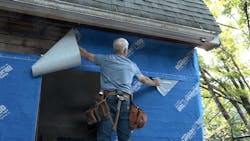
A crucial step in the construction of any building wall assembly is a layer of house wrap. Officially made a code requirement by the International Residential Code (IRC) in 2006, house wrap is classified as a water-resistive barrier (WRB) installed on top of the wood framing of a home and underneath the exterior siding. “It’s the skin on a building,” according to builder David Joyce. Its primary purpose is to keep moisture, winds, and other extreme weather conditions from reaching the interiors of homes and to prevent the framing beneath from rotting.
House wrap first appeared on the scene in the 1960s with a product called Tyvek, developed by researcher Jim White at DuPont. The material, a “strong yarn linear polyethylene,” according to the official DuPont website, was discovered in 1955 but required years of extensive testing to perfect the complex manufacturing process. Before this development, builders would simply use tar paper as an early WRB. Tyvek was eventually brought to the commercial market in April of 1967 and has had a massive impact across numerous industries, including construction.
When first introduced to the world, house wrap was only available as a mechanically fastened product, meaning it had to be installed in the old-fashioned way: with nails or cap staples and sealing tape. The next evolutionary step was a self-adhered house wrap, an adhesive-backed roll that simply requires the user to peel and stick the WRB to the house without the need for extra tools. Since the introduction of self-adhered house wrap, it has become a prominently used product in the residential and commercial construction industry.
How does WRB keep houses dry?
A major factor behind a house wrap’s performance is its permeability rating. Permeability refers to the efficiency of a material’s ability to allow water vapor to pass through. For house wrap, you want a product that stops bulk liquid water from seeping into the structure but also allows moisture to escape from within through vapor transmission so that the wall can dry out.
Measured in perms, house wraps will often have perm ratings assigned to them to determine how permeable the product is. According to the International Code Council (ICC), house wrap must have a perm rating of at least 5 to be considered vapor permeable. Anything below this would make the product a vapor barrier, which would allow no water passage and could soon lead to rot. It needs to be able to breathe.
Higher perm ratings allow for more water vapor to pass, making products with higher ratings (such as Dorken Delta-Vent SA or Protecto Wall VP) ideal for climates with extreme moisture/humidity. Builder Aron Jones wonders if that much is needed outside of those extreme environments, however. “For most of the stuff that we install, 10-20 perms is going to do the job.”
Water-resistive barrier vs. weather-resistive barrier vs. vapor barrier: what’s the difference?
There is a bit of confusion as to what the term WRB actually refers to. While the IRC officially defines it as a water-resistive barrier, it’s worth clarifying the difference between the terms.
Self-adhered house wraps are considered water-resistive barriers since their main purpose is to keep water out and let water vapor escape. While it offers resistance to wind and other weather conditions, it is not defensive enough against these other factors to be considered a weather-resistive barrier.
A weather-resistive barrier is more broadly designed to keep homes protected from rain, wind, and other elements of nature. It protects homes from water, along with many other conditions that could potentially cause damage. Examples of a weather-resistive barrier include building paper, rigid foam, and ZIP System panels.
A vapor barrier, sometimes called a vapor retarder, is a material that stops any water from moving through it and offers no permeability. A sheet of plastic or a glass panel would be considered a vapor barrier.
Acrylic vs. Butyl: The Adhesive Wars
As the two most commonly used adhesives among self-adhering WRB brands, it’s worth noting what differentiates the two sticky substances.
As far as performance goes, acrylic is the superior choice when it comes to UV protection, long-term adhesion, and withstanding extreme temperatures. Its largest drawback comes from its higher price point.
Butyl is going to offer a more cost-effective option, as well as strong water resistance and flexibility. It also offers a higher initial tack in comparison to acrylic, which cures over time. That said, it is more likely to dry out long-term and does not perform as well against UV rays as acrylic.
An important factor of adhesives is that only a little can be applied to WRB, otherwise it can compromise its water diffusion performance. “The adhesive has to be very thin because we need to maintain vapor permeance,” says engineer Jonathan Smegal.
Benefits and drawbacks of self-adhered WRB
The most significant benefit that comes with a self-adhered house wrap is that it is an all-in-one product. The adhesive backing of the product makes additional tools like cap staples and hammers irrelevant to the installation for a quicker process and a more secure connection. The ease of installation also means it can theoretically be installed by just one person, as opposed to multiple people needed for a mechanically fastened.
Self-adhered WRB also offers more air sealing protection. With mechanically fastened house wrap, there is a greater potential for air to slip between the layers, considering its only attachment point to the structure is the areas that have been taped and stapled, with a lot of free-flowing material susceptible to wind penetration. “I just can’t air seal at all with something that’s not stuck on the building,” says Joyce. The continuous adhesion that self-adhered WRB offers provides a stronger and more consistent connection to the wall framing, resulting in less risk of air leakage.
An environmentally unfriendly consequence of adopting self-adhering WRB is the mountain of backing paper that builds up. Once removed from the product, this backing paper serves no additional use. Considering the amount of WRB used in a single job, this naturally results in a lot of waste. The backing paper cannot be recycled either, due to the silicone-based chemicals that it is lined with. Some companies are working to combat this, such as TYPAR, who are currently developing a WRB with a biodegradable release liner for a planned summer 2026 release date, but environmental concerns still remain.
There is also the issue of timing, with some builders claiming that mechanically fastened goes up quicker in comparison to self-adhered, which often requires more time to ensure that it is rolled on smoothly with no wrinkles. Those who have experience with both tend to swear by the efficiency of self-adhered, however, claiming it is worth the extra installation time. “It’s more work in that it takes a little bit longer, but it’s harder to screw up,” according to builder Michael Anschel.
Rules to remember for installation
-
Follow the manufacturer’s instructions
Each brand of house wrap is going to come with its own manufacturer-provided set of instructions. Following these steps will be your quickest route to success, as they will detail proper installation techniques and often answer any questions you may have about the product. “Contractors or the installers don’t always seem to be aware of the manufacturer’s instructions,” says Smegal. “Usually the installation instructions will cover everything they’ve done wrong.”
· Always start from the bottom and shingle additional layers
Shingling each layer as you move up the house is integral in keeping water from getting into the WRB. Should any water work its way underneath the exterior siding, this technique ensures that it will run down each layer of WRB until it reaches the bottom of the house, where it can dry. If installed incorrectly, the water could slide underneath the layer of WRB and work its way into the structure.
· Take UV exposure into consideration
When selecting your house wrap, it is essential to have a clear understanding of how long the WRB will remain exposed to the sun before the exterior siding is installed. UV rays will begin to break down all building materials, including WRB, when left exposed for long periods of time. This is especially important during high UV index months. Know your project timeline and the UV exposure limit of the house wrap before selecting a brand. These limits will often be longer for commercial house wraps compared to residential due to the longer timeline of commercial construction projects.
· Brand compatibility makes the job easier
While not a requirement, using products in your house wrap installation that all come from the same brand will likely offer an easier installation due to the brand compatibility that each product is designed with. So when choosing sealing tape or other accessories that will aid in your installation, be mindful of what brand of WRB you’ve selected and try to match the brand.
· Take extra care of wall penetrations
Any penetrations in your wall structure, such as windows, doorways, pipes, wires, and other elements of a house that break up the flat wall structure, are going to be the most susceptible part of the wall to weather damage. Take extra care when patching up these penetrations to ensure there are no leaky spots around them for water to seep in.
· Every brand is different
While they all perform the same task, each house wrap brand is going to vary from the others in little ways. Some will have a continuous layer of adhesive along the back of them (Benjamin Obdyke HydroGap SA); some will only have strips of adhesive (TYPAR DrainableWrap Peel and Stick). Some are going to require a primer application before placement (Henry Blueskin VP100), and others will be good to go without any primer (VYCOR enV-S). Some work perfectly fine in extreme temperatures (Protecto Wall VP), while others will only thrive in normal temperatures.
Notable Brands
Self-adhered WRBs have come a long way in recent years, with many different options to choose from. The consensus gathered from the experts we consulted for this article is that each brand will offer high-quality performance. “It’s way more important to install them correctly, install them well, and make sure that they’re actually put in place,” says engineer Kohta Ueno. Ultimately, it comes down to choosing a product that serves your needs and is best suited for the specifics of the job.
Henry Blueskin VP100
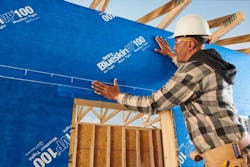
Being among the first self-adhered WRBs on the market, Henry Blueskin VP100 offers a vapor-permeable and water-resistive barrier for wood-framed houses, both residential and multi-family construction. Blueskin VP100 combines an engineered film with their patented permeable adhesive technology and split-back poly-release film to create a tight seal (even around nails and fasteners), eliminating air gaps and water/moisture intrusion, while achieving over 95% drainage efficiency.
Blueskin VP100 is a multi-layer polyolefin product made of polypropylene and polyethylene for the base sheet, and a custom hybrid-butyl adhesive backing developed by Henry. It has a UV resistance timeline of 150 days and a perm rating of 33.
“What helps set us apart is the whole balance of properties,” says Tom Baiada, Product Manager for Henry. “The permeability of the product, the adhesion level, and the support that we have for the product in the field.”
Blueskin VP100 is available in roll widths of 6”, 9”, 12”, and 48” and comes in a length of 100’.
Benjamin Obdyke HydroGap SA
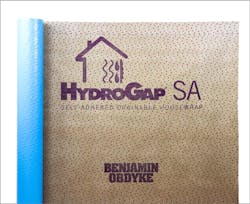
HydroGap SA by Benjamin Obdyke creates a full drainage gap by combining 1mm spacer technology with a fully continuous breathable 100% acrylic adhesive. Made of a polypropylene trilaminate, this air and moisture barrier allows for repositioning in case of incorrect installation. The mesh-like material of the product enhances its flexibility when tension is applied, while the acrylic adhesive prevents tearing during installation. As the adhesive cures, it seals around each fastener and penetration point for complete sealing.
“The acrylic adhesive will increase its bond over time, unlike a lot of other adhesive technologies where they become brittle or they could dry out,” says Kaylen Handly, Technical Innovation Manager at Benjamin Obdyke. “That long-term performance is really what was critical for us.
The drainage efficiency of HydroGap SA reaches 96% and removes water twice as fast as flat house wraps. Rolls of HydroGap SA come in a width of 57” and a length of 80’. It has a max UV exposure of 120 days and a perm rating of 12, making it an ideal choice for mixed climates, and it can be installed in temperatures as low as 25°F.
VYCOR enV-S
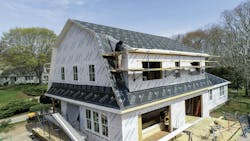
Combining traditional house wrap breathability with the weather protection that comes from a self-adhered membrane, VYCOR enV-S delivers strong weather protection and improved energy performance with a 97% drainage efficiency. Made of a polyethylene carrier film, the butyl-modified adhesive coating maintains vapor permeability and weather resistance even as it seals with the sheathing. No mechanical fastening or seam taping is required, as the adhesive seals around the fasteners used to install the siding.
VYCOR enV-S is a fully-adhered, lightweight product with a perm rating of 24-32 (dry cup vs wet cup). It can be left exposed for up to 180 days and can be used in residential multifamily, and low-rise commercial applications.
Rolls are offered in width options of 4”, 6”, 9”, 12”, and 40”, all with a length of 120’.
TYPAR DrainableWrap Peel and Stick
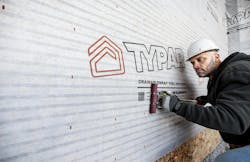
DrainableWrap Peel and Stick from TYPAR offers strong water protection with a 94.8% drainage efficiency. Made of a spunbonded polypropylene and backed with an acrylic adhesive, DrainableWrap Peel and Stick features durable tear strength and breathability, as well as a zone coated/strip adhesive pattern that allows for repositioning. It can be installed in temperatures as low as 10°F, making it a year-round product in most climates.
It has a perm rating of 10 (low for optimal drying) and can be left exposed for up to 6 months before UV damage occurs. It can be used in residential applications, with a forthcoming commercial DrainableWrap Peel and Stick slated for release in summer 2026.
“One benefit of our TYPAR portfolio is that every one of our WRBs have perms in the 10-20 ranges so regardless of SKU and market/application we are consistent in our building science beliefs,” says Andrew Irvine, Director of Product Line Management at TYPAR.
DrainableWrap is available in a 4' 10" x 100' size roll.
Other Brands
Aside from some of the aforementioned top dogs in the self-adhered house wrap market, there is no shortage of other brands available that some builders may prefer to use. Other options include Grip-Rite ProWrap SA, Dorken Delta-Vent SA, VaproShield PanelShield SA, Rothoblaas self-adhesive membranes, Protecto Wall VP, Pro Clima SOLITEX MENTO 3000 Connect, Sto Corp StoShield SA VP, and Siga Majvest 500 SA.
Products such as Huber ZIP System and LP WeatherLogic are other popular choices for builders. They are essentially wood panels with a WRB built into them, creating a two-in-one product that effectively eliminates the need for house wrap. While using these can be a time-saver, careful and precise taping is a must, and any damage to the panels requires the entire assembly to be replaced as opposed to just the WRB, so there is a give and take.
It is also worth noting that while Tyvek has not developed a fully self-adhering house wrap product, they have created a self-adhering barrier for window and door flanges called IntegrationWrap. While not a full WRB itself, it can be combined with Tyvek HomeWrap to connect the wall assembly to these openings and form a continuous weather barrier.
Which brand offers the best bang for your buck (and why it doesn’t really matter)
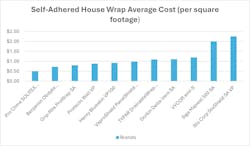
Examining the average retail prices of many of the major brands shows little difference in the overall cost when broken down per square footage. Most brands remain within the $0.50-$1.50 range, with the exception of some more niche brands, such as Siga Majvest 500 SA and Sto Corp StoShield SA VP, which are less widely available and harder to accurately price.
But while some builders may find themselves obsessing over cost, it’s important to note that at the end of the day, it’s all chump change. Each builder we discussed the percentage cost of house wrap in relation to the total cost of building supplies with reported microscopic numbers, ranging between 4% to as low as 0.5%. Other factors, such as perm rating, climate, and simply what is going to work best for the job, should take priority over the material cost, particularly when that cost is so minuscule.
“A big mistake would be choosing house wrap based on cost,” says Anschel. “It’s just not the decision point.”
Know your stuff (or risk a leaky house)
Kohta Ueno refers to WRB as a building’s “last line of defense against exterior water penetration.” It is an essential ingredient in the structure of a house in preventing rot, leakage, and all types of bad-weather-related ailments you don’t want to have to fix. Ensuring proper knowledge on all things house wrap and making educated choices during the choosing and installation process means you’re doing right by your customers, their houses, and the industry as a whole. Less rot means less callbacks, and that saves you and your customers a lot of time and frustration.
About the Author

Tyler Rhyan
Associate Editor, Products Coverage
Tyler Rhyan is the associate editor for Pro Remodeler. He can be reached at [email protected].