Grace Tsao Mase on What AI Actually Changes for Remodelers
Key Highlights
- Remodelers who use AI to explore materials and design options with clients in real time are cutting the design process from weeks down to minutes at the first client meeting.
- There's real money on the table. Billions in state and local incentives, tax credits, and rebates go untapped because the industry doesn't dig for them. Contractors can use AI to research them.
- AI won't replace remodelers, but it will change the job. Human judgment, taste, and client relationships still matter most; AI's edge is in the tedious work: cross-referencing plans, estimating, catching constructability issues before they become change orders.
- AI adoption is still early, with many contractors using AI for email and marketing, not field applications. But contractors can snap photos of problems or walkthroughs and use AI to get instant feedback on what to fix, cutting down on repeat inspections and change orders.
- Less experienced workers can use AI as an on-the-job training tool, helping them to get up to speed faster—which is important since the industry is short on skilled labor.


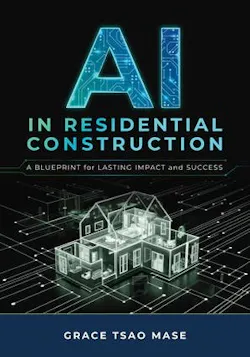
Grace Tsao Mase is the author of AI in Residential Construction, the founder of HomeRES.ai, an architect and a multi-state licensed contractor. She talked with us about how AI is helping remodelers find profit in incentives and build stronger trust with clients, and why critical thinking still belongs to the contractor, not an algorithm.
Jay Schneider: This is shaping up to be a strong year for remodeling. What have you noticed?
Grace Tsao Mase: This is a great year for remodeling. Out here in California, we've had a lot happen over the last few years. I'm still getting calls off the hook: "We need to remodel." I think people don't feel in control right now, and psychologically, doing something to their home is how they take that control back. I haven't run a full analysis, but there's a connection there.
What's exciting for our industry is the opportunity to upgrade these homes. Somewhere around 80% of homes today wouldn't meet current building codes for resiliency, whether that's fire, hurricanes, or something else. That's true across 150 million housing units nationwide. This is our chance to step up.
I've gone through multiple wildfires and earthquakes myself, and I've had friends lose their homes. It's heartbreaking, and these disasters are getting more frequent. Back in the '80s, the average gap between billion-dollar disasters was about 85 days. Last year it was about 10. That's a daunting responsibility for our industry, but also an opportunity to help clients understand the reality and do something about it.
JS: That's where AI comes in for you?
GTM: Right. I spend a lot of time researching incentives: tax credits, grants, rebates, you name it. There are billions of dollars available through states and jurisdictions that our industry doesn't dig deep enough to find. I actually built an AI platform, HomeRES.ai, just for that.
I want people to understand the research behind it more than I want to plug the platform. We built it thinking holistically, the way a homeowner does. They want their home stronger, their utility bills lower, their air healthier. As a contractor, I want to do great work and be profitable. Homeowners often assume an upgrade means more expense, but once you factor in stackable incentives, you're actually making money. A state insurance commissioner told me her state had over $20 million earmarked just for coastal communities to replace roofs. When a hurricane hits, the roof is the first thing to go, and hardening it gives homeowners a real fighting chance. Florida, Georgia, and Louisiana are among the states working to raise awareness of incentives like that.
JS: How do remodelers use HomeRES.ai?
GTM: We help them identify incentives and build them into the estimate, along with cost estimation. We give them good-better-best material options, and practical guidance, like converting framing from two-by-four studs on 16-inch centers to two-by-six on 24-inch centers for better insulation and lower lumber, time, and labor costs.
It also handles pre-construction document review. Once you upload documentation, it checks for constructability issues and cross-references against the architect's, designer's, or engineer's work, generating an RFI so those issues get resolved before the contract is signed. That cuts change orders and gets everyone starting from the same place. It's much cheaper to change the lines on paper than to change the framing later.
There's no way that at any point soon critical thinking and implementation will be completely taken over by AI...there's still a sense of style and taste it can’t replace.
JS: Your book cites a stat that only 2% of construction companies had integrated AI as of early 2025. A year later, what's changed?
GTM: More are using it but I don't have an exact number. Most contractors are using it for email, marketing, and maybe accounting, not for deeper field applications yet. I think we're still in a transition phase.
When I see an issue on a job site, I'll snap a photo and ask AI to walk me through it. Even though I have multiple state licenses, there's a lot I don't know, so when I upload a picture and ask AI to explain it to me, I instantaneously learn from that. And with the labor shortage we have, this is a great way for newcomers to learn faster and quickly ramp up.
JS: Is it fear or lack of awareness holding back adoption rates?
GTM: I think it’s a combination. AI companies aren't great at explaining exactly what you can do with these tools, and construction companies don't have time to figure it out. There's also fear it'll take jobs away. But a recent Anthropic study found that high-touch, physical work isn't likely to be replaced. Human judgment and interpretation and critical thinking still matter.
There's no way that at any point soon this kind of critical thinking and implementation will be completely taken over by AI. There will be some analysis, but there's still a sense of style and taste it can’t replace. What we do is so important.
JS: And it could free you up to do more of that critical thinking, the higher-level stuff.
GTM: Yes. I think that's a great way to look at it. What AI does is look for patterns. What's been done before. It’s not looking for what could be done, and specific to this location and this client. That's where we come in with that information.
Most contractors don't enjoy digging through plans and cross-referencing documents. It’s tedious work and it's repetitive. AI is great at that kind of work. If we’re doing an inspection or a walkthrough, we can upload photos and get immediate feedback on what to fix before it becomes a costly problem. It's a labor reduction and a time reduction. For me, everything comes down to what AI means for profit.
JS: AI can make you look smarter for having found ways to save money or a better way to do something before it becomes a problem.
GTM: Right! One of our clients who uses our platform said he’s a “superhero for his client." He walks in prepared, helps them think beyond convention, and finds incentives to offset any added costs.
Clients want to feel like their remodeler is a partner and is there to protect them and be on their side. That is how we change the relationship entirely. We're no longer in a race to the bottom for the lowest bid but delivering actual value. Remodelers want to walk into every client meeting and feel like, “We have a good relationship and they trust me and I'm excited to work on this project.”
Remodeling is a huge investment. Financially and emotionally. They’re opening up someone's home, and that's almost like open-heart surgery on a space that's sacred to them. When you deliver peace of mind along with results, you've got a partner for life, and referrals follow.
A lot of contractors have been conditioned to assume homeowners won't spend more, so they don't even have the conversation, or they frame it badly and get shut down. AI can help reframe that discussion.
JS: What was the genesis for writing your book?
GTM: I was inspired to write it right after the wildfires around Los Angeles. Partly because I was helping my friend who lost everything and helping them to rebuild, going through the permitting process, talking to the fire marshal, the building inspectors, as well as the planning department.
By utilizing AI, our documentation didn't require a whole lot of iterations and we got everything permitted within three months, which was awesome.
What I saw in the field was people continuing to design and build things the way they always have, without the latest building science or incentive information that could improve fortification on a roof, windows, or the building envelope, and that frustrates clients who then have to endure multiple rounds of approval.
I want to show how quickly you can get that information from AI and fold it into permitting documents to cut the iterations and the frustration. Fire victims especially can't handle another disappointment. Anything we can do to smooth that path forward is what they need from us.
Our own home survived, but we still evacuated for five days. We hardened our own home and used tax credits to help pay for it. These are extreme cases you won't see in typical remodeling work. But the same principle applies: think about how to help your client do better. If we can do that, we're all better off.
JS: When researching your book, what impressed you about how remodelers were utilizing AI in their businesses?
GTM: Clients often can't articulate what they want beyond "I want this style or that style." Now they sit down together and use AI to generate images in real time so clients can see what their kitchen can look like. What used to take four or five weeks of design conversations now takes half an hour, and homeowners get genuinely excited seeing it.
It's also about framing a conversation. When remodelers clearly explain upgrade options, clients generally agree to them. They may grumble about cost, but they say yes because the reasoning made sense to them. A lot of contractors have been conditioned to assume homeowners won't spend more, so they don't even have the conversation, or they frame it badly and get shut down. AI can help reframe that discussion around what the homeowner actually cares about.
JS: What advice would you give to remodelers interested in utilizing AI but are unsure how to start?
GTM: Download Claude, Perplexity, ChatGPT, whatever, and just start talking to it like you would your superintendent. Describe a job site issue or a tense conversation with a client and ask for feedback. Ask it to ask you questions before it starts recommending anything. Just having a conversation is the lowest bar to entry. No prompting expertise required. And go into settings first to opt out of data sharing. Protect your privacy from day one.
About the Author
 Jay Schneider
Jay Schneider
Senior Editor
Jay Schneider is the Senior Editor for Pro Remodeler. He can be reached at [email protected].