Radical Transparency: Award-Winning Outdoor Spaces
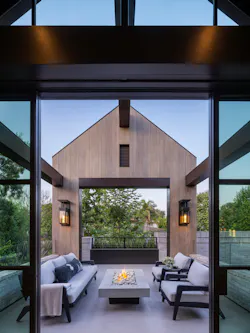
There’s a place called the Starlight Café in Terlingua, Texas, down in the Big Bend area across the river from Paso Lajitas. It’s a restaurant/bar/live music venue built from the remains of an old adobe ruin of a large rectangular building. It got its name because—as a ruin—it didn’t have a roof. You could gaze up at the stars while you dined or enjoyed the South Brewster All Stars jazz band playing in the corner. Once the business was successful, they went ahead and bought a roof. My reason for bringing up the Starlight Café is that it existed on the other side of the line that we usually think of when designing outdoor spaces. The goal of most outdoor spaces is to bring a little inside, outside. To bring some civilization to nature. The Starlight went the opposite direction, bringing more ’inside’ into the equation. Where one path crosses the other is the sweet spot in outdoor living design.
Great designs often execute the same concepts differently
In looking through this year’s Best in American Living Awards winners in the Outdoor Rooms/Spaces category, I saw a lot of overlapping design concepts—as you’d expect to see when looking at award-winning design. But while the projects share design concepts, the designs are spectacularly different.
Just like it does in new home construction or addition remodeling, the site presents opportunities and boundaries, so every design must usually be different be different. The site changes over the course of the day and season. Also, like regular living space remodeling and construction, you can add conditioning equipment to extend those seasons.
Successful designs incorporate multiple features, like decks, porches, patios, pools (and pool slides!), gardens, swings, and benches into a composition, the same way bedrooms, baths, kitchens, dining rooms, and reading nooks are curated into a home. Because frankly, we do the same stuff in those outdoor spaces that we do indoors: cooking, dining, entertaining, recreating, reading a book, even working.
You can connect indoors to out with products, materials, and illusion
Pocketing and sliding glass walls are standard features for indoor/outdoor connections, including the 20-foot pocketing doors at Patio 617 and the expansive glass sliding doors at Spyglass Modern. Through structural mirroring, you can use the home's interior features to define outdoor spaces. The Brentwood Residence features a "deconstructed" gabled roof that mirrors the interior vaulted ceiling, while Patio 617 uses exposed timber rafters to tie the cabana back to the main house. Another trick for visual continuity is to carry interior finishes outside, such as the Modern Family Estate, using matching quartzite for both indoor and outdoor kitchen countertops.
Tech upgrades evolve
Tech upgrades over the years have usually aimed to enhance our outdoor experience. Lighting and speakers were early tech upgrades that have matured over the decades.
Outdoor conditioning equipment began with ceiling fans and tall porches in the south; exterior conditioning has grown to High-Pressure "Flash Evaporation" Misting Systems and Bioclimatic Pergolas (Smart Louvers on Roofs) for cooling. Old-fashioned fire pits have evolved into gas-fueled fire pits and radiant heating systems; grills have grown into outdoor kitchens. In fact, outdoor cabinetry is an actual industry.
I didn’t see any Flash Evaporation in the BALA mix, but I did see some retractable weather screens, a lot of fire features, and tons of elegant lighting design.
One of the outdoor design concepts considered here is Topographic Articulation: Mastering the "Destination" through Grade changes. Niches can be created in proximity on the site plan, but with absolute separation in real life; one project uses a water slide to do that. The slide connects two “rooms,” while providing structural separation of others. Another concept is about architectural continuity, much of which comes down to product selection: things that look good—and work well—inside and out. Materials that can span both sides of a door (like flooring or siding). Products that eliminate the line altogether, like tall glass pocket doors. The third concept, invisible infrastructure, is about the essence of outdoor living: not interrupting nature with your tech but not going without either. Some examples in these projects include retractable weather screens, integrated lighting, infinity pools, and gas-powered fire features.
Essential elements in nature
Fire and water are essential elements, and they are found liberally in great outdoor designs. Water is often used as art as well as something to jump into or slide down. Fire shows up as traditional masonry fireplaces, gas-powered fire pits, electric fireplaces, and even as “accents.” There’s a reason we want to keep nature in our civilized natural spaces, and that’s because we are creatures of nature, and (controlled) fire makes us feel comfortable. It’s the same reason we have houseplants, fountains, and fireplaces inside the house. And it’s why the old Starlight Café was so effective at intimate dining: the sky was the limit.
Design Concept Panel 1
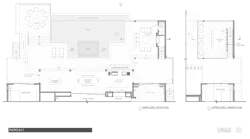
Topographic Articulation
Design concept: Mastering the "Destination" Grade
When a site isn’t flat, use the topography to create a sequence of discovery. These projects illustrate how to use varying elevations and slopes to define specific rooms without walls.
Example project: Patio 617. The site plan shows a masterful use of cascading levels that envelope the pool at the center, architecturally defining distinct spaces for dining, lounging, and fireside gatherings.
Design Concept Panel 2
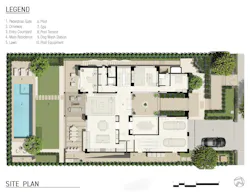
Architectural Continuity from inside to outside
Design concept: Indoor/outdoor connection
The most prominent theme is the erasure of the line between indoor and outdoor environments. This isn't just about adding a patio; it's about extending the home’s primary structural language into the landscape.
Example project: Brentwood Residence. The site plan shows drastic indoor/outdoor integration, beginning at the front door, where you can see through the house to the backyard.
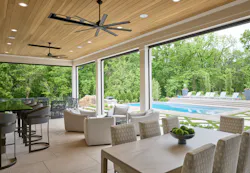
Invisible Infrastructure
Design concept: Create stealth performance layers
An outdoor room is only successful if it can be used 365 days a year. This spread explores the "behind-the-wall" engineering that makes luxury spaces perform like climate-controlled interiors without sacrificing the aesthetic.
Example project: Modern Family Estate. With automatic screen walls and overhead radiant heat integrated so cleanly, they don't disrupt the view of the multi-level pools or the putting green.
About the Author

Daniel Morrison
Editorial Director
Daniel Morrison is the editorial director of ProTradeCraft, Professional Remodeler, and Construction Pro Academy.