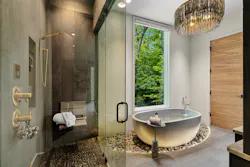
Laura Sullivan grew up on jobsites. Her father was a realtor, real estate investor, and house flipper, and she and her sisters would pitch in where and when they could. And she always had a creative side and an eye for detail. So, it seemed only natural that she’d end up doing something in residential design or construction. But there’s a twist! She pursued a career in health care.

“I got my certified nurse's aide license and I started working in a hospital. I really loved helping people, but I realized I didn't want to be in a hospital all day, every day doing this. I also loved art, but I wasn’t sure that I could make a living with it,” says Sullivan, the founder of Asheville, N.C.-based design firm ID.ology. So, she pivoted and enrolled in the interior design program at Appalachian State University where she received her Bachelor of Science. After graduating, she earned a real estate license and a general contractor license.
“I was doing a little bit of all three—design, building, and real estate—with my family’s business, but I came to a crossroads,” she says. “Then I met my husband, Sean, who owns Living Stone Design + Build, and I wondered how I could focus my knowledge and skillset to best help our clients.”
She founded ID.ology in 2012, and her clients (many of whom also are design-build clients) greatly benefit from Sullivan’s healthcare background, which drives her focus on designing for wellness and sustainability. “I still get to help people, just in a different way,” she says.
Designing for health and wellbeing
Wellness design involves thinking about a house holistically so that it prioritizes health, comfort, and safety. This philosophy resonated with Sullivan. “It was a natural fit because I’ve always thought about health and wellness and the built environment,” she says.
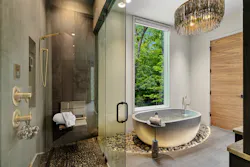
Biophilic design is another wellness concept that focuses on strengthening the human-nature connection. This can mean embracing natural shapes; bringing outdoor elements inside; capturing natural light; and using other natural materials like fire, stone, and wood. “There are a lot of studies that show the health benefits of biophilic design,” says Sullivan. “It’s been shown to help our circadian rhythm, reduce blood pressure, and increase emotional wellbeing. Our natural environment is very restorative, visually and physically.”
To further her understanding of these practices, she has earned multiple certifications, including Certified Green Professional, Certified Aging In Place Specialist, and Wellness Within Your Walls professional.
Focus on what you see and what you breathe
Sullivan stresses the importance of using healthy and sustainable products—which she succinctly explains as “choosing materials that don’t poison your space.” A major concern is off-gassing of toxic VOCs. “We build tight boxes and we want to make sure we’re not trapping our clients inside with materials and finishes that are not healthy to breathe in. Part of the design process is how we get that stuff out of the house.”
It’s become easier to find green products. “When I first started in design, there were very few products that were healthy, but thankfully, the industry has caught up,” Sullivan says. When she talks with new vendors, she always asks about their products’ green qualities and she scrutinizes the MSDS (material safety data sheets) so she knows their “recipe of chemical ingredients.”
“Part of our design work is not just picking out beautiful things and saying you should use this because it looks great, but to educate our clients so they're able to make smart decisions about the products we use,” Sullivan says.
Smart shopping for better living
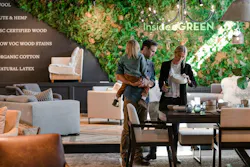
In 2019, Sullivan and her husband opened Atelier Maison, a 19,000-sq. ft. showroom that carries a curated selection of home furnishings that are healthy, sustainable, and non-toxic. Their thinking: It doesn’t make sense to build a green home and furnish it with items that pollute the indoor environment.
“We've worked pretty hard to find companies that are healthy because a lot of the manufacturing practices are still a little antiquated and the idea isn’t promoted as much within the furniture industry,” Sullivan says. The products they sell use FSC-certified wood, plant-based foam, non-toxic glues, organic textiles, natural latex, jute, hemp, wool, goose feathers and down. “We want to provide our clients with everything we can to help them to have a healthy space,” she says.
About the Author
 Jay Schneider
Jay Schneider
Senior Editor
Jay Schneider is the Senior Editor for Pro Remodeler. He can be reached at [email protected].