Remodeling Sector Getting Bigger and More Competitive

The remodeling industry is bigger than ever and there are a lot more players, according to the Harvard University Joint Center for Housing Studies, which analyzed 20 years of data about the remodeling sector.
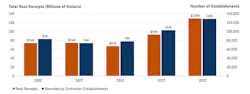
Consider the years 2012 to 2022; during just these 10 years, the number of remodeling firms increased from slightly less than 78,000 to more than 128,000. Billings nearly doubled, from $67 billion to $129 billion.
The growth represents a dramatic reversal from the years surrounding the housing bust when the number of remodeling firms decreased 10% before gradually recovering. Between 2012 and 2017 the number of firms increased by nearly one-third, and then another 25% between 2017 and 2022.
The Covid pandemic also provided a significant industry boost, with homeowners spending more than $600 billion on improvements, replacements, repairs, and maintenance in 2023, up from around $400 billion in 2019.
Remodeling Industry Grew After Great Recession and Through Covid-19 Pandemic
More Money, More Companies
The growth in billings was substantially greater than the growth in the number of companies. Average receipts per firm increased 20%, topping $1 million annually in 2022. However, this doesn't mean remodelers necessarily enjoyed a corresponding increase in profitability. During the same period, costs for materials, equipment, labor, and fuel increased, which affected the bottom line.
Perhaps more significant for established remodelers is what happened to the competitive landscape following the Great Recession: Thousands of new firms opened throughout the country, reversing a prior trend toward greater consolidation.
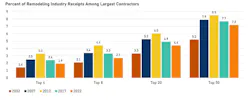
In 2012, the nation’s four largest remodeling firms accounted for 3.3% of all industry receipts but by 2022, their share had fallen to 1.9%. Similar trends are seen among the top eight, 20, and 50 firms. The industry's growth wasn’t dominated by a handful of large companies, but rather more businesses sharing a much larger market.
Growth in Remodeling Establishments Reduced Concentration
Remodeling Expands Beyond Traditional Markets
The industry's growth also spread geographically.
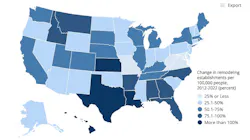
Nationwide, the number of remodeling firms per 100,000 residents increased by 55% between 2012 and 2022. In Louisiana, Kansas, Texas, and Hawaii the number of remodeling firms per 100,000 people more than doubled during those 10 years. The data indicates that growth is spreading throughout the country rather than being concentrated in markets with traditionally high remodeling rates.
Racial and ethnic ownership demographics have changed, too. The share of remodeling firms owned by people of color increased from 10% to 18% between 2012 and 2022. Hispanic-owned remodeling firms accounted for much of the increase, growing from 5% to 12% during that time period.
Change in Number of Remodeling Firms by State
A Big Opportunity and a Bigger Challenge
The data reveals an industry that has matured significantly since the Great Recession, with more contractors, more money spent on remodeling, and more markets supporting the remodeling industry.
But that growth also creates competition. For established remodelers, the challenge isn't simply finding enough work in a growing market, it’s standing out in a much more crowded field and remaining competitive and profitable in environment where higher labor and material costs are significant concerns.