
The good news: Most remodeling and home improvement crews get rave reviews from homeowners that lead to referrals for their employers. That’s likely because many firms have written plans and procedures in place outlining and reinforcing behaviors expected from their crews while on the jobsite. But also, because most crew members inherently act professionally and respect a customer’s home.
The bad news: Smoking is still an issue onsite. And some team members have highly inappropriate tattoos or drive vehicles displaying offensive bumper stickers. These are things that homeowners don’t want to smell, see, or have parked in front of their homes.
In November we published a poll asking Pro Remodeler readers to weigh in on employee and crew conduct in a customer’s home and tell us a little about their processes and procedures for managing jobsite behavior. Nearly 300 respondents answered, and we followed up with a few to gain more insight.
Here’s what we learned—and it didn’t always reflect the overall poll results.
Addressing professional conduct with employees/subcontractors before they enter a client’s home
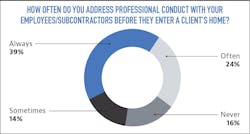
Most remodelers stress the importance of professionalism before employees even step inside a client’s home, with 63% saying they always or often address expectations for conduct. That means most firms consistently reinforce behavior standards upfront. However, only 29% said they have formal written policies.
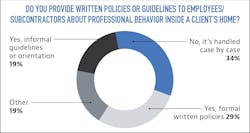
Kevin Erdmann, president of Erdmann Construction in Arlington Heights, Ill., says his firm has a 36-page employee manual that’s given to every new employee outlining exactly what’s expected of them on jobsites and what tools they’re expected to have based on their job title. “Everybody is given a job title, even if it is laborer, so that instills in them expectations about what they’re supposed to do,” Erdmann says. “The manual goes as far as breaking it down to the first thing you do when you arrive on the job for each person on the crew.”
Katelyn Reynolds, pre-construction specialist at Nicholas Design Build in the greater Indianapolis area, says her subcontractors are presented with a trade partner agreement that outlines expectations. “The trade partner agreement is probably the biggest part of setting the tone for what’s expected on the jobsite,” Reynolds says. “Rather than just having regular subs, so to speak, we emphasize that we are actually in a partnership with them to produce a great product and we have expectations for the stewardship of someone’s home.” The issues addressed include jobsite cleanliness, noise and music, appropriate behavior, and how crews should present themselves in a client’s home. No one gets hired if they aren’t on board. “If they’re not willing to agree on how to show up on a jobsite then they won’t be on any of our jobsites,” Reynolds says. She adds that it’s rarely an issue because they strive to be on their best behavior and live up to the agreement.
Todd Schulte, owner of Schulte Design-Build in Seattle, says that his project manager stresses to the crew members the importance of keeping their personal comments to themselves, noting that cameras are everywhere these days. “Our rule of thumb is assume you’re always being filmed, assume you’re always on camera.” He notes examples where crews who have been critical of a project or the homeowners have been recorded and reported. “Just be very careful and discerning when you’re inside someone’s home,” Schulte says. “Keep your personal comments to yourself and then go bitch about it in your truck while having your lunch.”
Discipling or removing an employee/subcontractor because of unprofessional behavior
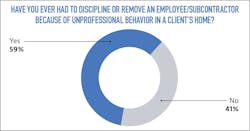
More than half of remodelers (59%) say they’ve had to discipline or remove an employee or subcontractor for unprofessional behavior in a client’s home—a reminder that professionalism on the jobsite can directly impact trust and reputation.
Jeff Fike, president of JF Builders & Assoc. in Apex, N.C., says when he has to disciple crew members, it’s never in front of the homeowners. And the infractions often are minor. “Some of our subs do new construction, which is completely different than working in someone’s home, right? So, they need to learn how to respect that environment and they need the appropriate training,” he says.
Reynolds has had a few situations that required intervention, including one where a trade partner was driving a borrowed vehicle—not their usual ride—with bumper stickers that made the homeowner uncomfortable. “If you are going to drive a vehicle that’s going to have a very crass or very strong bumper sticker of any shape or flag of any sort, that is not something we want on a jobsite,” she says.
Reynolds explained the situation to the homeowner and addressed it with her trade partner and that vehicle did not to return to the jobsite. She also noted an issue where trade partners didn’t work well together. “Somebody was in someone else’s way, and they threw their stuff against a wall. Not only was it a ‘You need to be off the jobsite immediately,’ situation, but I needed to talk about the escalation of emotions,” she said. “It was uncharacteristic of this person, but we’re not using them again.”
While these situations are isolated for the most part, many ongoing issues involved smoking on the jobsite.
Erdmann says smoking is one of his biggest problems, and the only place his crews are allowed to smoke is out on the street. “If I pulled up and saw cigarette butts anywhere on site or by their trucks, I told them they couldn’t smoke, period!”
Fike is similarly adamant. “There’s no smoking on or anywhere near the property. If someone has to have a smoke, get off the property, sit in your truck, drive around the block.”
And Schulte takes an even stronger stance, saying he likely won’t hire smokers. “I know that’s a pretty hard line, especially in our industry, but it makes sense because you can smell it on someone as soon as they walk in the house. It’s been one of the limiting factors for bringing up one of our lead carpenters as a project manager because it’s really hard to put someone like that in front of the client on a regular basis,” he says.
Additional Feedback
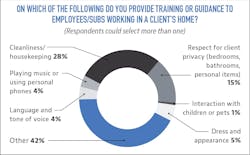
Ultimately, the message from remodelers is clear: professionalism in the home keeps the client’s trust. Establishing firm boundaries for respecting a client’s home is just as important as the quality of the work being done to it.
Jobsite Soundtrack
Long gone are the days when a crew member would blast the radio in their vehicle and leave the doors open so their music could be heard by everyone on the jobsite—and beyond. These days, most crew members tend to use their own devices with their own playlists and they often wear earbuds—or earbud singular.
“It’s a safety issue, you have one ear open so you can hear when something is happening,” says Katelyn Reynolds, pre-construction specialist at Nicholas Design Build in the greater Indianapolis area. “However, volume level isn’t really a concern anymore because of earbuds, and the number of times I’ve had to deal with the issue is minimal.”
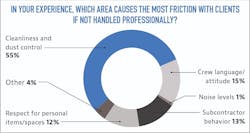
That mirrors what our poll revealed—music and jobsite noise isn’t seen as problematic, with only 1% of respondents citing it as a concern. Many remodeling firms address expectations for jobsite behavior with their crew as part of the project kickoff and volume level is among the issues discussed.
Interestingly, listening to music on the jobsite can have recognizable mental health benefits, according to various studies and surveys that show music can reduce stress and anxiety, boost mood, and help performance and focus. And then there’s the simple enjoyment factor. “Sometimes it’s just nice to have a little background music,” says Jeff Fike, owner of JF Builders & Assoc., in Apex, N.C.
What musical genres are most popular on residential jobsites? To find out, I enlisted ChatGPT as a research assistant.
Most popular on residential jobsites:
- Classic rock
- Country
- Spanish-language music
- 90s–2000s rock/alternative
- Hip-hop/rap
Pro tip: Tired of listening to your same old playlists? Head over to Spotify and search for public playlists built for those working on construction sites. I found “Jobsite Bangers” and “Worksite Bangers,” among others, and there are playlists curated by tool makers, including Ridgid and Milwaukee.
How crew listen to music on the jobsite
Earbuds are most common. Earbuds are most common. They allow people to listen to their own music, they prevent fights over playlists, and they are quieter, meaning less disturbance for homeowners and their neighbors.
Pro tip: Look for ear buds with IP ratings in the range of 56 to 68, which indicate the enclosures are resistant to dust, sweat, and water. The higher the IP rating, the better the protection. Additionally, look for units with a noise reduction rating ≥ 25 dB to limit exposure to hazardous noise and ones that cap volume output to ~85 dB and/or have “aware” tech or transparency mode to help maintain situational awareness.
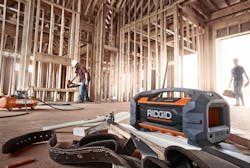
Radios/speakers are still common, but situational. They can create a team vibe and a sense of unity and they make it easier to maintain situational awareness. However, there can be disagreements over choice of music and they may annoy the homeowners or the neighbors.
Pro tip: Look for units that are waterproof, shock-resistant, and able to run on electricity or batteries. Some can also provide storage for small items and charge cell phones and cordless tools.
About the Author

Jay Schneider
Senior Editor
Jay Schneider is the Senior Editor for Pro Remodeler. He can be reached at [email protected].