Keeping Water Out: Flashing Windows the Right Way
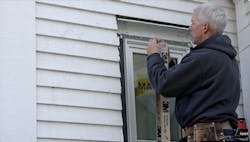
We don’t build waterproof walls. We build drainable ones. Every layer of a wall assembly—from the framing and sheathing to the WRB and flashing—works together to direct water where it already wants to go: down and out.
That simple principle underlies the Pen Test, a quick thought experiment that building scientists use to check continuity. If you can trace a continuous line along your air, water, and thermal control layers without lifting your pen, the design is sound. The same logic applies to flashing windows. The path for water should be unbroken, predictable, and sloped to daylight.
The two stages of window flashing
A flanged window is a joint between two worlds: the wet one outside and the dry one inside. To keep those worlds separate, you flash twice—once before the window goes in, and again after.
Flashing the rough opening protects the framing and sheathing from incidental moisture. Start with a sloped sill pan or flexible flashing that overlaps the WRB below. Add jamb flashings that overlap the sill piece. The goal is to create a self-draining pocket so that any leak that sneaks past the window can still drain out.
Once the window is set, the WRB integration begins. The lower flange tucks behind the WRB so that water above the window can shed over it. The side flanges overlap shingle-style, and the top flange laps over the WRB. Everything you do follows the same logic: the lower piece goes on first, the upper piece overlaps it, and gravity takes care of the rest.
It’s not just a checklist; it’s choreography. Every layer supports the one above it, creating a redundant, forgiving system. Tape can fail, caulk can shrink, but if the layers are lapped correctly, the wall still drains.
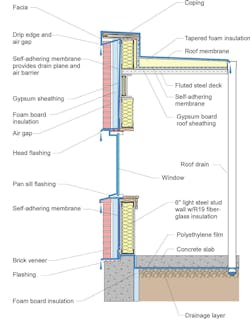
The Pen Test is an exercise invented by Dr. Joe Lstiburek, co-founder of Building Science Corporation, to train architects and engineers to get the details right “on paper” before they are built in the field. If you have to lift your pen off the page to draw the water protection layer, you have found a leak. This image shows a blue line tracing the water control layer: WRB above the window, to the head flashing, to the face of the window, to the sill flashing, to the WRB below. Illustration is from the EPA’s Water Management Guide
Extending the logic to thick walls
Add exterior insulation, and you introduce a new variable: depth. The wall grows thicker, but the physics don’t change. Water still runs downhill.
An innie window sits tight to the sheathing, recessed inside the foam. This approach keeps the window closer to the conditioned space and protects it from weather exposure. It works well when deep jambs are part of the design language—think European-style walls with pronounced shadows. To make it work, extend the flashing from the sheathing plane across the insulation to the cladding. Every surface the water touches should lead out and down.
An outie window, by contrast, sits proud of the insulation, near the cladding plane. This makes trim integration easier and simplifies flashing because the window’s flange aligns more naturally with the WRB. Systems like ZIP-R combine structural sheathing and insulation in one panel, making the “outie” position the default: the WRB lives on the exterior face of the wall, and the window installs just as it would on a standard framed wall.
Both strategies can succeed or fail depending on one thing: continuity. The window must connect cleanly to the WRB, which must connect cleanly to the flashing, which must connect cleanly to the drainage plane. Trace your pen again—you shouldn’t have to lift it.
The logic never changes
Whether you’re building a high-performance wall or just trying to keep rot out of a remodel, the principle stays the same. Gravity always wins. Flashing isn’t decoration; it's a structure for water removal. Lap every layer shingle-style, think in paths, not points, and your windows will drain for decades.
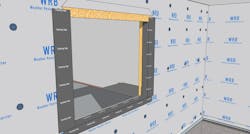
Panel 1: Flash the rough opening to protect the structure and prevent hidden air leaks through the walls
Window flashing stops air leaks and water leaks. Sill pan flashing at the bottom of the rough opening primarily provides water protection. The jamb flashing on the sides primarily stops air leaks through the wall assembly by bridging all its layers and tying the outer face of the WRB back to the framing. In this assembly, it bridges the gap between the WRB and the sheathing, and between the sheathing and the framing. Adding one or two layers of exterior insulation would add another gap or two for sideways air movement.
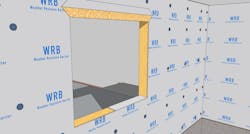
Begin by cutting the WRB flush with the opening: wrapping it into the opening means wrapping the gap in, where it won’t likely be sealed. Cutting the WRB flush with the opening aligns all the gaps, making it easier to seal them. Also, cut a flap in the top of the WRB so it overlaps the window flange easily.
Either slope the sill plate or add a piece of beveled siding to slope the sill plate—either way. Make sure you’re not making the rough opening too small when doing so. The sill flashing should extend up the jambs at least 4 inches and to the face of the WRB below.
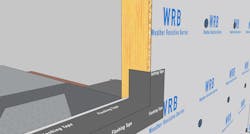
Jamb flashing overlaps the sill flashing, bridges the gaps in the framing assembly, and extends up to the flap at the top. While extending the framing to the face of the WRB is enough to stop air, a best-practice upgrade is to ensure the jamb flashing is wide enough to protect the joint where siding meets trim—a likely water-entry area.
Panel 2: Flash the window into the WRB to keep liquid water out, and allow drainage for accidental leaks
After the window is installed, it must be integrated with the WRB: tucking behind it at the top and overlapping it at the bottom.
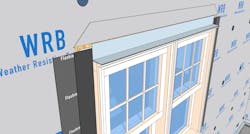
The flanges are sealed to the rough opening jamb flashing with an additional layer of flashing tape. The top flange is then sealed with another layer of flashing tape, overlapping the side flange tape, and the top WRB flap is folded over the top flange tape. The 45-degree relief cuts are sealed with construction tape. Now, water that gets behind the WRB above the window can escape at the window head.
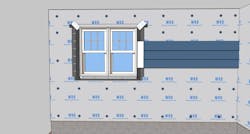
Below the window, the flange is left unsealed so that any water leaking into the window assembly can drain out. It is a good idea to leave the bottom flange unnailed to avoid restricting drainage. Some builders even slip shims behind the flange to create drainage paths.
Also noted in the illustration is to consider where the flashing tape will be when cap-stapling the WRB: Keep cap staples about a foot away from the rough opening to avoid interfering with flashing tapes.