The New American Remodel 2026: Soft Touch, Big Impact
The New American Remodel Home 2026
Location: Winter Park, Fla.
Home size: 3,413 square feet
Lot size: 0.42 acres
Bedrooms: 3
Bathrooms: 3.5
Builder/remodeler: Phil Kean Design Group, Winter Park, Fla.

Like many smaller, older homes in affluent communities, the future of this 72-year-old mid-century ranch was anything but certain when it hit the market in 2023. Many homes in wealthy Winter Park, Fla., have been torn down and replaced with larger and more extravagant properties, and this house could easily have been razed not remodeled.
“I debated what to do with it—fix it up or tear it down,” says Phil Kean, who is both the home’s owner and the CEO of Phil Kean Design Group, the design-build firm that tackled this remodel. “There are $20 million homes on the street and the lot is particularly large, so I thought maybe it could be torn down and replaced with an $8-9 million house. On the other hand, I was enjoying having a big yard for my dogs, and it is a pretty street.”
Also working in the home’s favor: it had good bones and was very livable at just over 3,400 square feet. “The people who had lived here before had taken good care of the home, you could tell it was well loved,” Kean says. “They were good stewards for something like 30 years.”
So the design-build team showed it more love and embarked on a “soft remodel” to help the property realize its full potential. The result is The New American Remodel 2026 show home.

Soft Remodel
“The whole house actually had enough square footage, it just really needed to be opened up and have better flow,” Kean says. “We took things out, we added things, but there was no addition and the only thing I did structurally was add parapets and raise the roof in the family room.”
“With a soft remodel you can get a lot of ‘wow’ by making a few key changes,” says Chris Kaba, vice president of construction at Phil Kean Design Group. “You don’t have to go up or go out—you can work with what you have to not only create interest but maintain the hominess and coziness of a house. It’s probably more reflective of what a lot of homeowners are doing, updating their spaces to make them more livable.”
Kean agrees and says another big advantage to undertaking a soft remodel is cost. “I tried to keep it to a reasonable budget and have it be representative of a remodel that’s achievable for the average person,” Kean says. “It was still expensive, but in our neighborhood it’s modest compared to other remodels.”
However, a soft remodel adds an element of difficulty because you have to work around a lot of things that are staying in place. “You have to be a lot more careful because you’re not really changing all the MEPs, which are your mechanical, electrical, and plumbing, so you try to keep those intact and then just connect the new to what’s existing,” says Tal Shuford, the project’s construction manager. He adds that since this wasn’t a full gut job, they tried to keep as much of the existing plaster walls as possible—although he notes that it did start to resemble Swiss cheese.
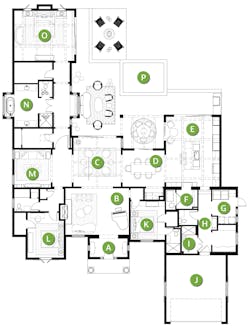
A) Entry foyer B) Living room C) Family room D) Dining room E) Kitchen F) Pantry
G) Laundry room H) Drop zone I) Dog wash station J) Garage K) Bedroom suite
L) Bedroom suite M) TV room N) Primary bath O) Primary bedroom P) Plunge pool
Interior Interest
When originally built, the home was small—four rooms total, with two-bedrooms and one bathroom—and then gradually expanded over the years. “It’s had multiple transitions. I figured there was something probably done in the 70s, something in the 80s, something in the 90s, and then probably something about 25 years ago,” Kean says. There was a mishmash of styles, different ceiling heights, and an awkward flow from room to room. Kean and his team were challenged to make all of it feel like it was part of the same house. “You have 70 years of a house having five renovations and additions and nobody really orchestrating it. You have a sense that each time they were trying to make it better, but they didn’t. They never addressed cohesion,” Kean says. “But now the house has a cohesiveness.”
The biggest changes inside focused on improving flow, sightlines, and adding architectural details. For instance, at some point in time an outdoor porch off the living room was enclosed and used as a family room, but its ceiling was never raised while its floor was. Entering the house, you’d see this room and have a good view of its ceiling (sloping to about seven feet at its lowest point) but your view out to the lush backyard was really squeezed. “When you walk in the front door now you can now see the garden, but the way it was before you kind of knew there was something out there but you couldn’t see it,” Kean said. “The ceiling really sloped down so your eyes were focused on the ground and not at the sky. By raising that ceiling up, your eyes now look out to the gardens.”


Access and sightlines were also opened up through the house on the east-west axis. You can now stand in the kitchen and look through the dining room and the family room to the TV room at the opposite end of the home.
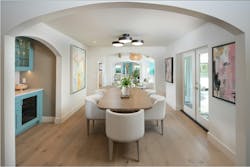
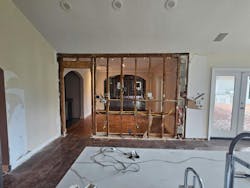

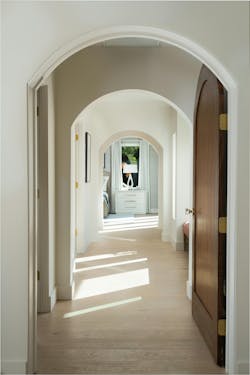
The kitchen itself was a good size and recently renovated but it was functionally awkward, isolated, and closed off. “You have all these rooms that are now open to one another and we delineated these spaces by creating these large archways,” says Kaba. “The arches really create visual interest and define the spaces. We did the same thing down the hallway to the primary bedroom wing. It’s a lot of eye candy, if you will.”

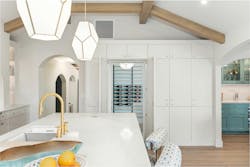
Another area that got opened up was a multiuse space between the kitchen and the garage that seemed to have no real use. This “nothing room” as Kean calls it, used to be the garage before a new garage was added during an earlier remodel. “You step down a couple of steps and there’s an angled pathway through there so you had a lot of wasted space. And the pantry was all the way back by the garage, not up by the kitchen. We straightened out this hallway and added a real mud room and a drop zone. We turned the old pantry into a dog washroom.” And the hallway has a series of arches that architecturally connect this space to the rest of the house. “It’s one of my favorite parts of the renovation,” Kean says.


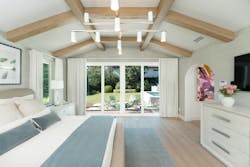
Primary suite 'eye candy'

New ‘Retro’ Exterior
Outside, the house was transformed into a style the team calls tropical Miami. “I’ve always been fond of that retro cottage-style you see in Coconut Grove and Coral Gables,” Kean says. “And the house itself has a really lush yard, so there was a tropical feel to begin with.”
And the team leaned into that South Florida vibe. The home’s three front gables came down and up went decorative parapets (one was also added to the back when the family room ceiling was raised), the old corner windows were replaced and recentered on the front façade, and decorative shutters were added.

The new parapets are an especially significant design element. “The house felt particularly squat compared to the mansions all around it with two and three stories and 20,000 square feet,” Kean says. “I wanted more of a presence, and the parapets add about four feet of height to the house. It looks more elegant and more properly scaled.”
Kean said that before the remodel, you could drive down the street every day and look right past the house. “Now it’s something you notice. You drive by and think, ‘Oh, what a cute cottage’,” Kean says.
The fundamentals of a soft remodel were also followed outside. “When we did the patio, we picked up all the brick, stored it, and then put it back. And when we did our roof work, we did the same thing with the roof tiles,” Shuford says.
They also retained a few exiting patio doors and the large front entry door. “We could have replaced things, but they were still functional and replacement wouldn’t have made it better,” Kean says. “That’s part of what made it a soft remodel, not just trashing it all.”



The project was completed in a tight seven months to ensure the house would be show ready. Kaba says this remodel likely would have been a 12-month build. “In a perfect world we would have had more time, but everything was choreographed perfectly,” he says.
“When you don’t touch everything, the whole project goes faster,” Kean notes.
Meet the Project Team

Members of The New American Remodel (TNAR) 2026 project team include (back row L-R): Elisabetta Valesi, FF&E purchaser/expeditor, Phil Kean Design Group; Tal Shuford, construction manager, Phil Kean Design Group; Tommy Watkins, president, Phil Kean Design Group; Chris Kaba, VP of construction, Phil Kean Design Group; Todd Atkins, Sr. kitchen designer, Phil Kean Design Group; Jessica Young, design-build coordinator, Phil Kean Design Group; Gabriela León, Sr. interior designer, Phil Kean Design Group; (front row, L-R): Ashley Birmingham, lead interior designer; Robert Hanbury, TNAR 2026 task force chairman; Jamahl Gibbons, manager, IBS show homes NAHB; Tucker Bernard, executive director, NAHB Leading Suppliers Council and TNAR program; Annette DePaepe, Sr. interior designer, Phil Kean Design Group. Not pictured: Amy Thrasher, VP client engagement & marketing, Phil Kean Design Group; and Elizabeth Nivison, administrative coordinator, Phil Kean Design Group.

Phil Kean
Project Team
Builder/Remodeler: Phil Kean Design Group
Architect: Architecture by Phil Kean
Structural Engineer: Independent Forensics Group
Landscape Architect: Redmon Design Company
Energy & Green Building Consultant: Two Trails, Inc.
Project Partners
Gold
- GE Appliances (Monogram Brand)
- Jeld-Wen
- Kohler
Silver
- AHF
- Coleto Brands: Progress Lighting & Kichler
- VintageView
NAHB Leading Suppliers Council Contributors
- Amrize
- Barron Designs
- Carrier/Kidde
- Cornerstone Building Brands
- EMTEK Products Group /
- Fortune Brands Innovations
- Fi-Foil Company
- Fisher & Paykel
- Gladiator GarageWorks
- Huber Engineered Wood
- LiftMaster
- Lutron
- Midea
- Sherwin-Williams
- Simpson Strong-Tie
- Westlake Royal Building Products
Participants
- AXIOM Fine Art
- Bedrock Wireless
- Caesarstone
- Carpet Source of Winter Park
- Clopay
- Concrete Foundations Association
- Concrete Options, LLC
- Cowtan & Tout
- Cuisine Ideale
- Edwards Concrete
- Euclid Chemical
- FanTech
- FF Systems
- Florida Door Solutions
- Paradise Pools
- Pentair
- PlexiDor Performance Dog Doors
- Rinnai
- SteelCrest Corporation
- Storch Entertainment Systems
- Storm Solutions, Inc.
- Tidelli Outdoor Living Orlando
- Travis Industries
- Vanguard Furniture
About the Author
 Jay Schneider
Jay Schneider
Senior Editor
Jay Schneider is the Senior Editor for Pro Remodeler. He can be reached at [email protected].