Do Solar-Powered Attic Fans Work?
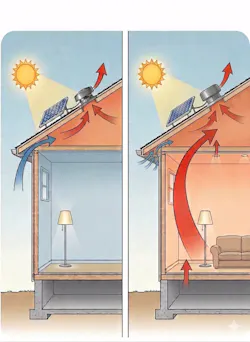
Solar-powered attic fans have an undeniable appeal. Peter Yost, building enclosure consultant with Building-Wright and my old partner at Green Building Advisor, put it well:
"They're really cool because if you wanna move air through the attic when the sun is shining, when it's also hot up there, it's like, hey, you get the energy when you need it."
Peter and I first dug into this topic together back at GBA in 2009. He wasn't exactly a "fan" then. After revisiting it recently, not much has changed.
The concept is simple enough. "You just cut a hole in the roof," Peter says, "and then if you're not wiring it because it's solar-powered, you just sort of let it do its thing, and maybe add a thermostat so that it only runs when the attic gets hot." Since the PV panel produces direct current, you pair it with a DC motor. "The electrical energy produced by the PV panel is direct current; you just use a DC motor, and DC motors are really efficient. So that's what's slick about it."
Peter has measured roof surface temperatures near 185 degrees in hot climates, with attic air temperatures topping 170 degrees. So if it's 100 degrees outside, you're still pulling in air that's 70 degrees cooler than what's baking in the attic. On paper, that makes sense. Because on paper, life is simple. If you want air to go somewhere, you draw an arrow, and it works—on paper.
The path-of-least-resistance myth
Here's what most installers miss. "The first thing is that any exhaust fan, everybody says, pulls air according to the path of least resistance," Peter explains. But that's not quite right. "It pulls proportional to the resistance of individual pathways."
The practical implication is understanding where the resistance is. "If you've got a big hole, yeah, most of the air that it's pulling is coming from there. But there are other pathways, and they don't just shut off." Can lights, ceiling fan boxes, gaps along wall tops—they all stay open. "If they are smaller and they represent more resistance, they just pull less air."
"Even though the arrows show that it's only going in the desired direction from the vent ports out the fan, that's not the way it works. They don't pull to the path of least resistance. They pull proportionally based on the resistance of each path. Some paths are wider than others."
A chimney chase is a good example. "The code says you have to have a two-inch gap between the framing and the chimney chase. Most chimneys are not sealed with non-flammable metal around that gap. So if you're turning that fan on, it's going to pull from that hole just like it's pulling from the place that you want it to (the soffit vents). And the air coming through that shaft is coming from inside the conditioned house."
That means the fan can actively pull conditioned air from the living space into the attic. And if there are connections to a basement or crawl space, it may be drawing moisture or soil gas up through the entire building assembly along the way.
The moisture problem no thermostat can solve
"Here's the second problem," Peter says. "We vent attics not only to keep them from getting too warm in summer, but the code is mainly about venting to control moisture. So why do a lot of fans only have a thermostat when, if too much moisture gets into the attic, I wanna pull in outside air to reduce that moisture?"
One answer is to add a humidistat. But that creates its own problem. "The humidistat is in the attic,” he says before pointing out that often, it is more humid outside then inside.” “… so now you're pulling in air that has more moisture," exactly what you do not want. Think about a hundred-degree day in New Orleans with 70% relative humidity.
"Maybe what I need is two humidistats, like one outside and one inside, and then write the control logic," Peter says. "All of a sudden, you've taken this really simple standalone solution, and you've made it a lot more complicated." What was once a self-contained, solar-powered fix is now a multidimensional mechanical logic center.
How to do attic fans right
There is a right way. But it starts before the fan.
"Is there a way to do it the right way? The answer is yes," Peter says. "But if you don't want it to pull from unintended locations like the top-floor ceiling (the attic floor), you better have an airtight lid. Seal the attic first."
Step two: plan on more than a simple solar setup. "If you're gonna install a fan, you'll probably need more complex controls. You will need to include a battery or wire it for current, because there will be times when you want it to run when the sun isn't shining."
And step three: consider whether you need the fan at all. "The right way is to first air seal and insulate your attic," Peter says. “And then you probably don't need an attic fan, regardless of whether it's wired or solar-powered."
Thermodynamics: you cannot manage heat without affecting moisture
"Here's the basic moral of this to me," Peter says. "At face value, this is an elegant solution. But most things in building science are never just about energy. The physics involved with building science is about hygrothermal," meaning moisture and heat.
Every time you try to separate heat management from moisture management, the physics intervene. "You'll have an unintended consequence when you try to manage energy and ignore how the moisture is behaving."
The most durable fix is the least exciting one: air-seal and insulate the attic properly, and most of the symptoms the fan was supposed to treat will disappear on their own.
This column is adapted from the Seven Minutes of BS podcast, featuring building enclosure consultant Peter Yost of Building-Wright.
About the Author
 Daniel Morrison
Daniel Morrison
Editorial Director
Daniel Morrison is the editorial director of ProTradeCraft, Professional Remodeler, and Construction Pro Academy.